My newest Sansa mp3 player has slow, normal, and fast modes for podcast play. The fast mode increases the rate at which sound is played back. And the idea is clearly to get through material faster. A side effect is that the pitch of the sound is increased. It's like playing a tape faster than it was recorded. There are techniques for playing back a digital recording faster, without changing the pitch, but this unit isn't doing that. There are both computational and quality advantages to the way the Sansa does it.
I measured the speed at which fast mode plays. It takes 80% of normal time. So, a track which would normally take an hour will take 48 minutes. That's a 12 minute savings. The speed is therefore 1/0.8 = 1.25 times normal. As an aside, in marketing, people do the sale percent math inconsistently with each other, often making it difficult or impossible to predict what the final price will be. This case might be reported as either 20% faster or 25% faster. I'm trying not to be sloppy.
Some of the podcasts either have music introductions, or the show is actually about music. So, for example, i listen to my friend Craig's Open MetalCast. He interviews artists, but also plays tracks from their albums. I was curious how the pitch changes for music and voices. How would one figure this out? It should be a case of a little math.
A piano keyboard is organized into octaves. Each octave going up in pitch has a frequency that is exactly twice as fast as the previous octave. Now, you might think that there are eight notes in an octave - since the oct prefix means eight. The notes are labeled A through G, which is seven notes. The eight comes from counting the note that you start on. So, in this case, A is counted twice. And, indeed, there are eight. But, there are 5 black keys interspersed. There are a total of 12 notes to an octave. You still have to count the starting note twice. It's a fence post problem. The way to solve fence post problems is to think about each one carefully. Otherwise, you'll be off by one.
In the modern equal tempered scale, each half note - adacent keys on a piano, has the exact same frequency ratio as any other adjacent keys. Since there are 12 steps in an octave, and an octave gives you a factor of 2 frequency change, the ratio for a half step is the 12th root of 2, or 2^(1/12).
Now, remember that the speed change is a factor of 1.25. If we want to find out how many half steps that is, we need to know how many times we must multiply the 12th root of 2 by itself to get 1.25. So, here it is in algebra. We just need to solve for x.
(2^(1/12))^x = 1.25
We can take the logarithm of both sides and preserve the equality. It doesn't matter what base log you use. Your calculator may have a base 10 logarithm funcion labeled "log", and a natural logarithm (base 2.718...) button labeled "ln". The Windows calculator, in scientific mode (use the View menu), has these.
log(2^(1/12)) * x = log(1.25)
we can divide both sides by the constant log(2^(1/12)) and get:
x = log(1.25) / log(2^(1/12))
Plugging this into a calculator:
x = 3.8631371386483481744438331538727
This is the first thirty two digits of the answer. I'd be very surprised if the full answer has fewer than an infinite number of decimal digits. Since i only measured the speedup to about a part per 1000 (to the second over about 17 minutes), the result should be rounded to 3 significant digits, or 3.86. So, the speedup is more than a minor 3rd, and closer to a major third. It's not exact. So, all music played this way will not be in an A 440 based key.
As an aside, the quartz crystal used to regulate how the sound is produced is likely accurate to at least nine significant digits. A part per billion. It's quite possible that the manufacturer designed the speedup to be arbitrarily exactly 25% faster. In that case, nine digits, or a value of 3.86313714 might be justifiable. Or, again, who knows, the manufacturer could have wanted A 440 music to stay A 440 (but transposed), and set the speedup to be about 1.25992105 times faster (to get a major 3rd).
Anyway, more or less a major third. What's interesting is how a major third changes everything. Many voices are nearly unrecognizable. The tonal quality of voices generally change dramatically. There are very few spoken voices that you thought were typical deep male radio voices that you'd consider at all deep when played faster. Many adult voices sound like children. And music vocals, singing or rap, change in character similarly. But instrumental music usually sounds pretty normal right away, or pretty normal after a few seconds.
What amazes me about this is that my musical sense of pitch is quite relative, not so much absolute in nature. I can't tell you if a piano is a half step flat, generally speaking, even if i play it. Sometimes i'll accidently play a left hand part in the wrong octave without noticing. Yet, the character of the voice is quite apparent.
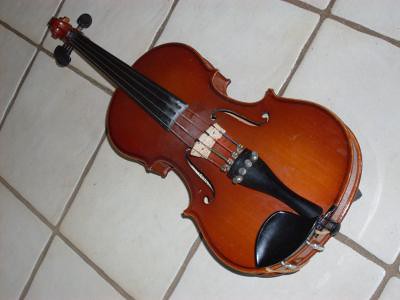
Another aside, when i play violin, i carefully tune each string with an electronic tuner. If a string goes out of tune, it generally goes out of tune with respect with the other strings. Once my brain has an absolute reference, i can get the instrument to play accurately pitched notes. There are no frets on a violin. You have to put your fingers in the right spots to get the right pitches.
In the mean time, there is a little music in my podcasts. This music, when played up a major 3rd, often sounds odd for a bit, then i get used to it. There is the odd piece that doesn't translate. For example, Beethoven wrote the Moonlight Sonata in C# minor. You can get a sheet music version transcribed (transposed down a half step) in C minor, which, having fewer sharps and flats, some people find easier to play. If i hear it played in C# minor, then hear it in C minor, it sounds disturbing to me. But if my piano is consistently tuned a half step down, and there's no absolute reference, i'm totally cool with it.
Anyway, this is a little thing. There's a function on my mp3 player. A curious thing, and i was curious. Was there more to think about for this function? Maybe. This musing was well within my comfort zone. I just sort of rambled around and played with what appeared interesting in my most distracted ADHD sort of way. But Bruce Lee had a different idea. He said, There are no limits. There are plateaus, and you must not stay there; you must go beyond them. If it kills you, it kills you. Bruce was into martial arts. A little curiosity won't kill you, unless you're a cat.


 So, this is an empty bottle of
 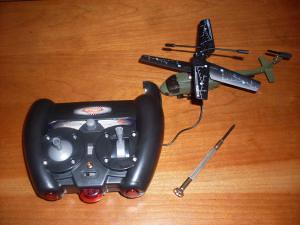 Excerpt from a toy helicopter's directions: "In if the flight does not have the impetus to change the operating lever, but the helicopter still in airborne spun, by now might adjust in your hand on remote control's vernier adjustment knob, balanced does not spin until the helicopter."
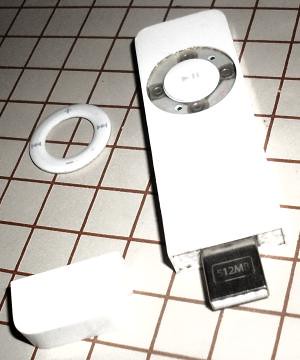 My original iPod Shuffle classic isn't dead yet. Fortunately, the ring came off while i was at my desk, and i saw where it landed quickly. I doubt i could get another ring. It appears that the ring was simply glued on in such a way that the bubble buttons underneath can be pressed with it. So, all i should have to do is glue it back on. There are a couple protrusions on the back side of the ring that allow the ring to be aligned properly so the symbols match up.
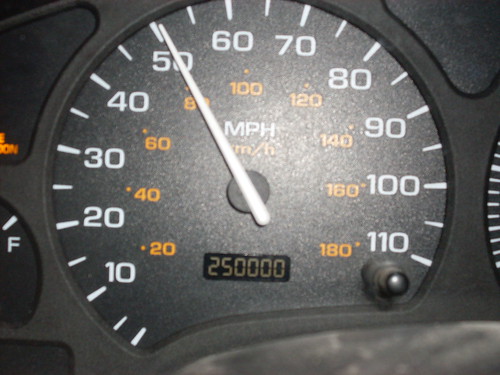
 But, i'm willing to bet that you won't use it. Here's how it works. Here in Michigan, the speed limit is 70 MPH (112 KPH). It's legal to drive at 62 MPH (100 KPH), but what people do is drive 75 or 80 (120 to 130 KPH), risking a speeding ticket. But i drive at 62 MPH. That's because there's a handy 100 KPH marking on my speedometer pointing straight up. And, my measurements show that the difference in fuel economy between driving at 70 MPH and 62 MPH is 17%. I ran these tests on four very different cars.
 The other day, the phone rang. It was a sales call. I call it phone spam.
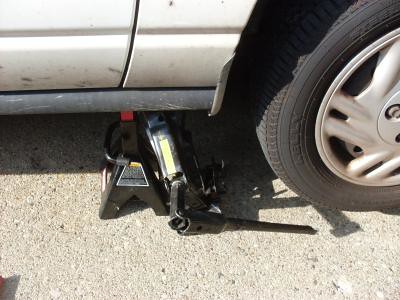 I thought i'd mentioned it in a previous post here, but can't find it. When jacking up the car to do maintenance, i always put something under the car, so that if the car falls off the jack, it's easier to jack it back up, and, by the way, nothing under the car get crushed. I'm thinking of myself, for example.
 But the best is yet to come. You really have to check out
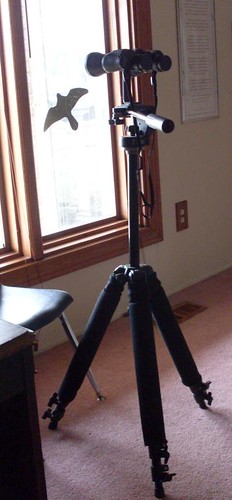
  The kite circled the tree once, then landed in it. Apparently, it didn't see the Blue bird. Apparently, being bright blue doesn't mean that you get eaten whenever a hungry kite comes by. The Bluebird didn't move. After a bit, the kite took to the air and decided to hunt for something on the ground. This was done by flying to what appeared to be an arbitrary spot to hover. And by hover, i mean that it appeared that it's head was somehow locked in an invisible vice maybe 40 feet in the air. The wings moved, other things moved, but the head did not. You could point the scope at the head. The tripod didn't move, and neither did the head. And after a bit, the kite would suddenly make a dramatic turn, and maybe 50 feet over, it would lock it's head there. What a show. Magnificent. After maybe twenty minutes, the kite went over the field, harassed a flock of Starlings, then flew back up and over the mountain.



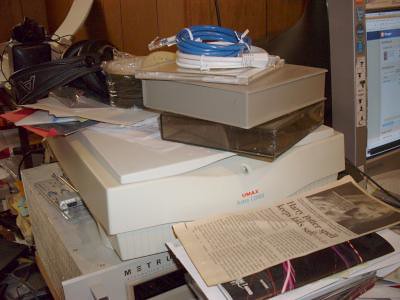
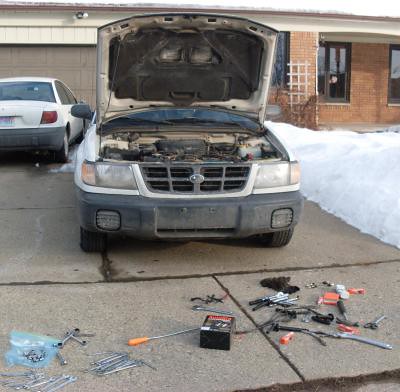
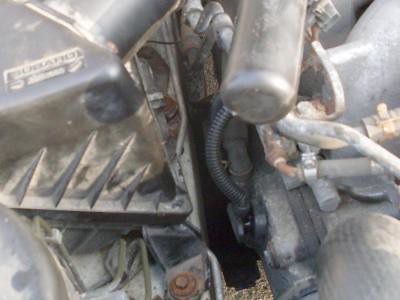
 I was going to join the Entire World Procrastinator's Society (EWPS - pronounced "oops"), but haven't gotten around to it.
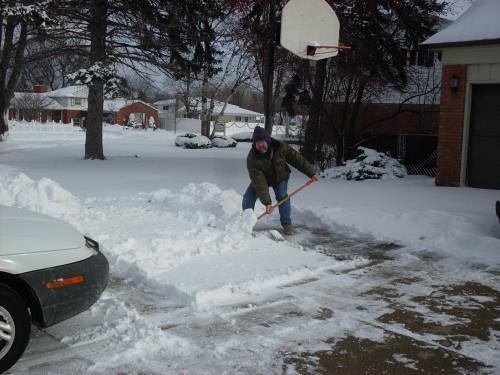 I'm considerably less enamored with winter today than i was yesterday. But while i was out there shoveling, one of my neighbors down the street got stuck with her car inches from freedom. Her front wheels were caught in the hard packed snow that the plow had left at the end of her driveway. So despite having 90% of the car in the road, the car refused to go anywhere. She's a good deal older than i am, so i walked over, cleared out the snow behind both front wheels, and then another neighbor and i pushed the car into the street while she drove.


 Posts
Posts