So, Jerry Falwell is dead. I've linked to a site with a video of one of the better euolgies. If you don't have a high bandwidth connection for the video, you can at least read the blog. But the video is priceless. I hope when i'm dead, someone has the guts to stand up and say it like it was.
Falwell was pretty much beyond delusional. And now, he's going to burn in hell, contributing to Global Warming.
Friday, May 18, 2007


Tuesday, May 15, 2007
Ten Percent
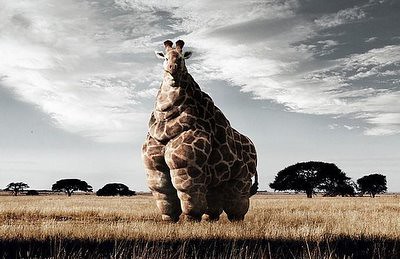 One estimate of the total number of people that there have ever been on Earth is about 60,000,000,000 (60 billion, or 60 thousand million). There are currently about 6,000,000,000 (6 billion, or 6 thousand million) people alive on Earth. So, ten percent of all people who have ever lived are still alive today. Clearly, the chances of not ever experiencing death is ten percent. This isn't extrapolated from a small sample. This is a one hundred percent sample.
Do you want to live forever?
Sunday, May 13, 2007
At The Deathbed of Darwinism
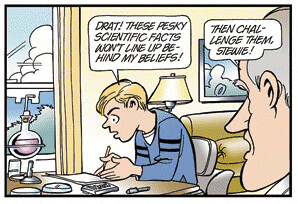 I've just finished reading At The Deathbed of Darwinism. It's newly available on Project Gutenberg. It was publish in 1904, and was a collection of papers written by E. Dennert, Ph.D. I look at the work from an historic perspective. I'm not an historian, but have interests in how things are figured out, or not. It appears that many great ideas come from people with no significant standing. For an excellent example, see The Reminiscences of an Astronomer, by Simon Newcomb. And, a great many poor ideas come from people who one would think should have known better. This is one of those. It proves that anyone can get a doctorate. If you've wanted a doctorate - go for it. Remember, you heard it first here.
From the title, one might think that Darwinism is just about to vanish from scholarly thought. But over a hundred years have passed, heredity was being discovered, genetics was developed, tons of experimentation has been done, and the essential bits of Darwin's On the Origin of Species is still considered solid truth, more than ever. So what happened?
It's not that easy to pull it out. For one thing, this collection of papers rambles. The translation is excellent. Through it, you can still get the feeling of someone grasping at straws, any straws, to find evidence that supports the author's conclusions. And make no mistake, the conclusions were drawn first. Then the evidence is weighed. And, if the evidence does not support the conclusions, the evidence is downplayed, explained away, outright ignored, or out and out falsified. And pointlessly. But this isn't good science. It's non-science, which can be shortened to nonsense. And this is how the author argues. If it is too hard to argue with a speaker's ideas, then attack the character of the speaker.
The first question to answer is, what motivation does the author have? He spells it out. He considers Darwinism to be an affront, really an attack on Christianity. Why it is such an attack is hard to guess. The author is either silent, misleading or vague on this question. It could be because a literal interpretation of the Bible has God making the Universe in six days about 6,000 years ago. It could be because the author is uncomfortable with being related to apes, or even distantly related to slugs. Some of these things bother people today. They shouldn't. In particular, my own Christianity is completely compatible with the evolution of animals, including humans. It is completely compatible with the origin and evolution of the Universe. And, being related to slugs gives my life a connectedness to life on Earth, and a relationship with the Universe, in all it's glory. The ancient Biblical word translated as "day" could be as easily translated as "era" or "epoch", without a stated length. At that point, it is largely compatible with the Big Bang and Evolution models. And even if it wasn't, Genesis has moral lessons, like the fall from grace, and i never expected a history of the Universe.
The other bit about the book title has to do with the word Darwinism. Christianity is a belief system. The title, Darwinism, is not. One does not say "I believe in Darwinism". One might say, "Darwin's theory of natural selection is a powerful mechanism to explain the evidence". But if extraordinary evidence became available that suggested that Christ never existed, Christians would still be Christians. Yet if extraordinary evidence became available that showed that Darwin was wrong, scientists would drop it like a stone. That's because it isn't a belief system. That said, both Christianity and Science are attempts to learn truth. And truth is truth. Darwin's ideas weren't great because Darwin was a great man. Darwin was a great man because his ideas have stood the test of time.
E. Dennert, Ph.D. attempts to argue that natural selection doesn't work. He embraces all sorts of people who have ideas that might replace this concept. But it should be pointed out that these other ideas also support descent in general. That is, one species changes or branches into another. These ideas simply have other mechanisms. But natural selection, of itself, isn't the idea that is so offensive. Descent is. And this fundamental problem doesn't seem to be noticed in the text. And the flow of the ideas suffers from it. So the author dances around the problem. But in the end, you're left with the feeling that since Darwin introduced descent, he should be punished, and it doesn't matter how.
His first attack is a series of four questions.
1. Is there any evidence that such a struggle for life among mature forms, as Darwin postulates, actually occurs?
Apparently E. Ennert, Ph.D. didn't get out much. My cat ate all the chipmunks, moles, mice, and even rabbits in the neighborhood. Only the Grey Squirrels survived.
2. Can the origin of adaptive structures be explained on the ground of their _utility_ in this struggle?
He seems to argue that if there any features of any organism anywhere that can't be explained, that the theory must be wrong. But Darwin also talked about sexual selection and other factors that are conveniently forgotten.
3. Is there any reason to believe that new species may originate by the accumulation of fluctuating individual variations?
There is now, of course, with genetics, evidence down to the molecular level. But there is also considerable variation in just siblings, available to the author.
4. Does the evidence of the geological record--which, as Huxley observed, is the only direct evidence that can be had in the question of evolution--does this evidence tell for or against the origin of existing species from earlier ones by means of minute gradual modifications?
He uses this question to launch an argument of the gaps. If you have two fossils A and C that differ, then where is the intermediate form? When such a form B has been found, the argument now asks for two new fossils: one between A and B, and one between B and C. But even Darwin suggested that the intermediate forms would be very rare. And rare they are, though certainly non-zero. There is also evidence for speciation among living creatures, plants and animals.
So that's the first ten percent of the book. It continues on in a meandering manner. It continues to using logic that is frustratingly close to correct while consistently missing the mark. It is not much fun to read. I'd much rather read up on a null result experiment.
OK, so E. Ennert, Ph.D. was biased going into the work. And so was i. I owe a considerable amount to Darwin. If Evolution didn't work, then modern antibiotics wouldn't work. Without modern antibiotics, modern surgery wouldn't work. Without modern surgery, when my gall bladder ruptured and became gangrenous, i'd have died a painful death. Clearly, it's time for a prayer of thanks to God for Darwin.
Wednesday, May 09, 2007

Thursday, April 26, 2007
In Particular
 I blamed my cube mate for getting me into the particular habit of using this one particular word to particular excess. When writing a any particular essay, if a particular word is repeated particularly often, i'd look it up in a thesaurus and consider a synonym. When speaking, there's much less editing, and any particular word that comes to mind comes out of the mouth.
But this particular word isn't my cube mate's fault, or at least, not exclusively. It seems to have infected many people. I hear it in podcasts. Live interviews, that is interviews without a script, seem to be filled with this one particular word.
I've not looked it up in a thesaurus. I know a synonym that fills the same purpose. Silence. Read this again, but skip that one word each time it occurs. Does it still make sense?
Friday, April 20, 2007
Guilty
OK, so it's been a year, and i've calmed down. More or less. Last year, the City of Southgate, MI, issued me a speeding ticket. Fort Street is a three lane in both directions boulevard - which is to say that it is divided by a grass median. I pulled onto the street by making a right turn at a light. I then crossed two lanes to get into the left most lane. That's when the bubble lights went on. The officer claimed that he clocked me doing 37 MPH. There were two conflicting problems with this. First was that in the distance i had just traversed from a stop, my car doesn't get up to 37. Second, was that, well, so what? This street has a 45 MPH limit, at least. The fact was, i wasn't pushing it. I had gone to the far left lane because the business that i was to visit had an odd address, suggesting that it was on that side of the street. I'd need to be closer to that side to avoid missing it.
But crossing two lanes of traffic is suspicious. I didn't cut anyone off, or pass anyone, but there was other traffic, and that's that. The officer was not swayed by my story in the slightest.
I wanted a day in court, but when i called the number for the court on the ticket, i was presented with City Hall voice mail hell. There was no entry for the court. I fumbled for a few days, trying to figure out what to do, and realized that the deadline for paying the fine was coming up. Screw it, i'll just pay the fine. Well, they don't accept checks, there's no address to go to to pay in person - which leaves a credit card. That can be done by phone, but for an outrageous surcharge. Perhaps someone better at bureaucracy would not be found guilty as charged with no evidence, and no representation, guilty with no chance to be proven innocent.
I went back to Fort Street, and verified that my car can't accelerate to the speed quoted by the officer in the distance available. I drove around and found that the speed limit is 25 MPH. But in neighboring towns, this same road indeed has 45 MPH and 50 MPH limits, even though the business strip density is identical. So this strip of road has an arbitrarily low speed limit, coupled with high enforcement. I wouldn't call it serving the public, i'd call it milking the public.
There's a clear message that Southgate was sending me, and in the past year, i've taken it to heart. It says, "We don't want your business". I haven't been back. And it is clearly too bad for those businesses. Thousands of dollars lost.
Friday, March 30, 2007
abiword
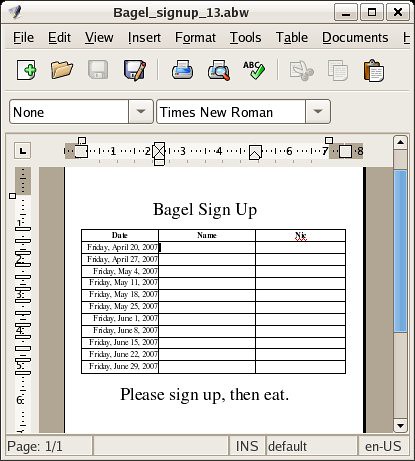
The modern version of abiword, 2.4.6 could not be installed under Red Hat 9, at least, not without upgrading so many shared libraries that it wouldn't be much like Red Hat 9 anymore. So, shared libraries have prevented me from upgrading my operating system in an incremental manner, preserving my historic functionality. I'm totally forced to upgrade everything, lock, stock and barrel.
I wanted to give the new abiword a try ever since i heard that it now supports tables. Really, word processors don't need the kitchen sink. With tables, abiword has everything i need. One thing i don't need is glacial speed start up times. And, since abiword is so much smaller that OpenOffice, or modern versions of MS Word, it has fast start up times.
So, after spending hours upgrading to Fedora Core 5 (yes, i'm aware that FC6 is out, thank you very much), and then untold hours getting FC5 up to my minimum functionality, i told yum to install the latest abiword. At least this installation wasn't a problem. The install put a link to abiword in the standard applications menu - office. Convenient.
My very first example page for abiword requires a three column table. There's a header in the table at the top, column headings, and some noise at the bottom.
One nice thing, for me anyway, is that abiword let me type in the dates the way i wanted them, without comment. It expects me to know what it is that i want to type, and lets me type it.
This is not what OpenOffice 1.0 did. By default, the table cell format includes "Number Recognition" - which includes dates. So, i type "Friday, 20 April, 2007", and a tab, and the cell then has "04/20/07". What? How do i get my text back? Well, one of the date formats is "Friday, April 20, 2007". It's not what i want. Really, it could be the world standard, but i want the month name to break up the two numbers. Really.
In OpenOffice 2.0, "Number Recognition" is turned off by default. With it off, i can get the format i want by typing it. However, it still attempts to complete the words for me. So, when i've typed "Fri", it adds "day". I don't look at my hands, i look at the screen. So, this brings my 70 words per minute typing to a halt for a second or two while i figure out how to get the rest of the word. It's worse than you might think. The column is right justified, and i want to set that before typing, so that when rows are automatically added to the table, they get the formatting too. So, the text i'm typing dances left and right as the software adds and subtracts it's guess as to what word i'm typing. I usually end up by just finishing typing it. It's quicker than trying to figure out if OpenOffice guessed the right word. The whole thing is so distracting that i feel compelled to perform at least two proof reading checks to see if i've got what i want. I've no idea how to turn off
this "feature".
Back to abiword. In my first printing, the left column printed quite a bit wider than it showed on the screen. Sure, the other two columns are blank, but it's a sign up sheet. You need more room when doing handwriting. That was a wasted output page. So, i selected the columns and formatted them exactly the way i wanted. That worked. I was not able to go back and reproduce the original bug, even with a brand new document. I'll have to watch for it to happen again. But it's not my karma. I generally get to see all the bugs just once.
All software has at least one bug. Every program can be reduced in size by at least one line. Therefore, every program can be reduced to a single line, which is a bug.
I like where abiword is going in functionality and style. It's a keeper.
Thursday, March 22, 2007
Close without Saving
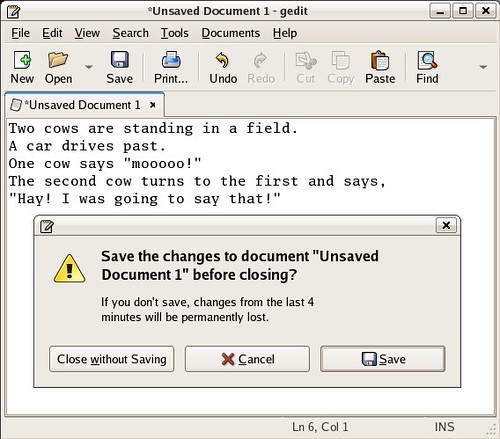
I've recently upgraded from Red Hat 9 Linux to Fedora Core 5. Yes, i'm aware that FC6 is out. This post is about something i've not seen before in over 30 years of computing.
This application is gedit. This is the gnome project's answer to the Window's notepad. Except that it works with large files, and isn't otherwise broken. I don't use it for serious editing because it doesn't do keyboard macros, doesn't have an extension language, and, well, isn't EMACS. But sometimes i need a sort of scrap book of things to copy and paste. So here, i've put some temporary text into a file, and when i was totally done with it, i clicked the X in the upper right to exit. This dialog came up. The new thing is "Close without Saving", which actually says, unambiguously, exactly what it is that i want to do. This is a big improvement over the industry standard.
Tuesday, March 20, 2007
New User Interface
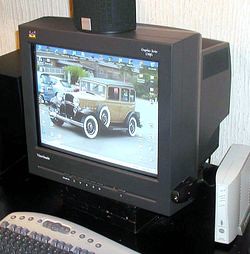 We're patenting a new user interface concept. It's an accelerometer built into your computer monitor. The idea is that when (not if) something goes wrong, and you smack the monitor, that this information can be sent to the computer, which can realized that it has been hit, and start working properly. At present, smacking the monitor is clearly the moral equivalent to shooting the messenger. But current monitors respond just as well as if you shout at the top of your lungs, but the wall is deaf.
Wednesday, March 14, 2007
Passwords
Computer people (that's me) try very hard (sometimes with miserable results) to make software allow people to do things easily. That sometimes makes it easy for people to do things unreliably. If you don't know what you're doing, you still don't know what you're doing.
Security is one of those things you simply have to know. My advise: write all your passwords down on sticky notes and put them on your monitor. Sure, from a security standpoint, this is terrible. Anyone looking over your shoulder (even if your shoulder isn't there) could get into anything you can. But at least you'd know what you're doing.
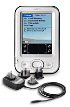 I mean, are you really going to do what i do? I keep my passwords encrypted on my Palm Pilot. Not only is my Palm backed up, but i have an identical Palm that i periodically restore to. If the Palm is lost, no one will be able to get my passwords. If my Palm breaks (computers are not immortal, and portable computers are particularly mortal), then i can use my backup unit. If both are lost, i can buy a new one, restore to it, and get back on the air. If my backup computer is stolen, i can buy a new computer, restore from my off site backup, buy a Palm, restore to it, and i'm back on the air. When the Universe (Murphy) is out to get you, paranoid is just good sense.
Security is one of those things you simply have to know. My advise: write all your passwords down on sticky notes and put them on your monitor. Sure, from a security standpoint, this is terrible. Anyone looking over your shoulder (even if your shoulder isn't there) could get into anything you can. But at least you'd know what you're doing.
I mean, are you really going to do what i do? I keep my passwords encrypted on my Palm Pilot. Not only is my Palm backed up, but i have an identical Palm that i periodically restore to. If the Palm is lost, no one will be able to get my passwords. If my Palm breaks (computers are not immortal, and portable computers are particularly mortal), then i can use my backup unit. If both are lost, i can buy a new one, restore to it, and get back on the air. If my backup computer is stolen, i can buy a new computer, restore from my off site backup, buy a Palm, restore to it, and i'm back on the air. When the Universe (Murphy) is out to get you, paranoid is just good sense.
Monday, March 12, 2007
In need
Overheard this morning.
Is there anything else you need?
Yes. I need another hour of sleep. Can you get me one?
I'm new here. Let me check the desk.
Is there anything else you need?
Yes. I need another hour of sleep. Can you get me one?
I'm new here. Let me check the desk.
Friday, March 09, 2007
Signs In The Sky
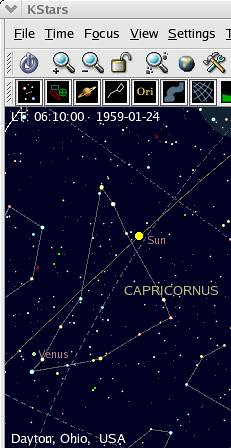 If you view my profile, you'll see that i'm older than i look. And, yes, exercise, diet and clean living have made quite a contribution. But you'll also see things that aren't intended.
For example, you'll see Zodiac Year: Dog (bow wow, or some such). This would be the Chinese year. I didn't write that. It was computed (correctly) from my birth date. From Chinese restaurant place mats, i'd long thought that i was a Zodiac Year: Pig (oink, oink). But since there was a full moon within hours of the Winter Solstice in 1958, the Chinese new year (based on a lunar calendar) came fairly late in 1959, at least a week into February. So, it's all gone to the dogs for me. I read a 60+ page pdf on the subject, and that's my best guess. Yet, despite all my calculations, i know little and care even less about Chinese astrology. Even if it was a brown dog year.
But there is also a bullet point, Astrological Sign: Aquarius. Now most people would say that January 24th makes me Aquarius. But if you examine the above image, the Sun was clearly in Capricornus - so i'm a Capricorn, right? So why does nearly everyone say i'm Aquarius? Well, that's because astrology has been around for a long time, and the Earth has had enough time to move in it's precession of the equinoxes. My guess is that since the changes have been quite slow, astrologers, who basically do what they've been taught, haven't updated the dates for the zodiac signs.
I'm not here to bash BlogSpot for making bogus calculations. I'm not here to bash astrology in it's various forms. My point is really that not everything you read is either correct or even what was intended. In this case, since i lean more towards astronomy than astrology, if you want to know what i think of my birth sign, it just isn't the historic Aquarius answer. Oh, and you'll be hard pressed to convince me that the alignment of the Sun on my birthdate to the arbitrary grouping of stars we call Capricorn has any cosmic significance to me or anyone else.
I normally post this sort of thing on my Live Journal blog, which i've attempted to devote to astronomical humor. But that blog doesn't put my signs in my profile.
Tuesday, March 06, 2007
Book It
As a parent of a ten year old, i have to say that the Book It program is good. There's a real problem getting kids up to the level of reading for enjoyment. That's the point at which the effort required to read is less than the return. Once they're there, getting them to read is no problem, generally. Just put books they'll like in front of them.
Book It did not get my child through this hurdle. The primary incentive was that (mostly) i read to him every day. I read stories that i knew he'd enjoy. Then, on October 11th, 2005 (it was a Tuesday), he crossed it. He went from kicking and screaming to get through five minutes of reading he had to do for school, to reading for six hours at a stretch on his own. This crossing really happened all of a sudden. And he went from hopelessly behind his class to reading over level in a few months. More on that in a bit.
Though the Book It program didn't do it, it did help. And it probably helps get lots of kids through reading for enjoyment. Pizza Hut runs this program. Many schools and parents cooperate by keeping track of what the kids read. At the end of each month, if the child has fulfilled the minimum requirement, they get a coupon for a personal pan pizza.
OK. I recognize that Book It amounts to a "buy one, get one free" sort of deal. He gets his free pizza, but i buy my own. And Pizza Hut doesn't lose money. On the contrary, i probably go there more often than i would without this program. It's still a good idea.
One result is startling. The house was quiet the other day. On a sneak inspection, i quickly opened his door, only to find him reading Shoestrings.
So, Book It has critics. But obesity is not one of my son's problems. And one personal pan pizza a month is not going to make any difference. You may consider pizza to be junk food, but it isn't banned by the South Beach Diet. If pizza has a problem, it's that it tastes good. My spaghetti has this problem too.
So, how do you get a child to read over level? Easy. Once (s)he's reading for enjoyment, put a book in front of them that's slightly over their level that is compelling. For example, Harry Potter. Rowlings deserves all the accolades she's gotten, and more. Six months after really starting to read, he'd read the first five books. Why didn't he read book six? Well, it wasn't out yet.
Having gotten him through reading, i'm now working on arithmetic. He was at the grocery store with me the other day. He wanted yogurt. Sure, it's filled with sugar, and probably isn't the best for him, but i still meter them out at just one per day. The pack of 6 was $2.69. While at the store, i asked him how much each one was. We did the division problem out loud. 6 goes into 26 how many times? 4. What's 6 times 4? 24. What's 26 minus 24? 2. Drop down the nine for what? 29. How many times does 6 go into 29? Five. Five? Oh, sure. He's doing estimates in class. So each yogurt costs how much? 45 cents. How much is Michigan tax? There's no tax on food. Then we bought it. I've edited out the spots where he didn't get to the next step instantly, of course.
Next up is science.
Tuesday, February 20, 2007
Goldberry
I've read The Lord of The Rings twice. And, yes, i've seen the movies. But the other day, i started listening to an unabridged audio production of the work. Just this morning, i've finished Chapter Seven - The House of Tom Bombadil. The chapter is fairly full of Goldberry - the daughter of the river who stays with Tom. Tom fetches nice things for Goldberry. Goldberry and Tom pursue errands for their guests in perfect concert, but without seeming to coordinate. It's a lovely scene.
But all i'd remembered of it was when Tom sang a song and the Willow tree released the hobbits. And, of course, when Tom put the ring on, and nothing happened. Fair Goldberry was lost to memory. Tom's power is evident and remarkable. Goldberry's power is subtle and forgettable.
Of course, the movies cut Tom and Goldberry out altogether. Not even a mention. The hobbit's journey through the Old Forest was cut too. Well, that's to be expected. Tom is not a player in the drama - just a spectator. And books are long, and movie screenplays are short. Something has to go, even for long movies.
So, just now, i'd like to raise a toast to what's-her-nose.
The audio, unlike the book, can really sing. The lyrics have melody.
And so on...
But all i'd remembered of it was when Tom sang a song and the Willow tree released the hobbits. And, of course, when Tom put the ring on, and nothing happened. Fair Goldberry was lost to memory. Tom's power is evident and remarkable. Goldberry's power is subtle and forgettable.
Of course, the movies cut Tom and Goldberry out altogether. Not even a mention. The hobbit's journey through the Old Forest was cut too. Well, that's to be expected. Tom is not a player in the drama - just a spectator. And books are long, and movie screenplays are short. Something has to go, even for long movies.
So, just now, i'd like to raise a toast to what's-her-nose.
The audio, unlike the book, can really sing. The lyrics have melody.
Ho, Tom Bombadil,
lives his life with what's-her-nose.
Cares for the Forest,
brings his love another rose.
Talks to the hobbits,
engages with the elven folk,
All the time, he laughs and sings,
Every thing's a Merry joke.
And so on...
Friday, February 16, 2007
Ida - an audio book
I like writing reviews, but delayed writing this one. I don't like to write negative reviews, and I'm still not sure if this one will be positive. Well, for one thing, there is the halting problem, and i can't predict how this review will come out before i'm finished with it.
So, the audio book is about 12 hours. However, each of the 32 audio files has an introduction by the author, and, and i hate this word, an outro (outroduction). And here is the first thing i didn't like about the presentation. Timothy apologizes for his Philadelphia accent before you even get to hear him read. Guys - if you're presenting a show, let the audience decide if they like it themselves. Don't make us pity you for being too stupid to get someone else to read your book. Don't go the other way either. It's OK to promote some other work of yours or someone else's, but just avoid it here.
After the first chapter, the introductions also contained a summary of what had gone on before. OK. So maybe the serial was released a chapter a week. Maybe some people can't remember what happened last week. I skipped all the introductions. The guts of the new chapter start after a bit of music, and my iPod was able to get me there in fast forward most of the time. I also skipped the outro's, which is easy enough, since he says that's the end. I don't have to fast forward, i can just skip to the next track. Since i skipped all that material, there was somewhat less than twelve hours of total material for me.
Another odd thing. After the book, Ida, was over, he offers in a single track, his book Balance. Balance is, by comparison, a short story. And, this story takes place well after the story in Ida. Ida is a prequel. It's a backing story to Balance. Like his introduction to Ida, Timothy apologizes for his book Balance. Jeez. For the record, i liked Balance better. As a short story, the pacing was much faster. Remember that reading a book to yourself is something like three times faster than reading it aloud. So, short stories with very fast pacing work better in audio format. And yet, Balance was long enough to give you the idea that several events actually took place. The events in the story were believable. The events were mostly related to each other. No laws of physics were broken in the making of the story.
The worst parts of Ida have to do with laws of physics being broken. They weren't broken like faster than light. They were more like having a character survive an acceleration of ten or twenty thousand miles per hour in a few seconds time. That would be something like 50 G's, minimum. Ouch. A little more explanation could salvage the suspension of disbelief, and oh, by the way, the plot. This suspension of disbelief nearly caused me to quit listening.
It's science fiction. It'd be nice to have someone vet the science by doing some math here and there. It wouldn't take much. Really.
The best part of the story was that there really is a plot. Things happen. Characters interact. Characters are changed by the events. They aren't entirely wooden. The characters are in space. Space is dangerous. So, the danger isn't just believable, it's expected. In fact, the routine spots are the less believable spots. What about cosmic rays? What about coronal mass ejections and other radiation? Dangers abound.
In all, the work had sufficient interest to make it worthwhile. Multi-dimensional characters. Character interaction. Believable responses. You can identify with the characters. Pick favorites and root for them. Suspense. And the end of the story was not simply telegraphed. There were plenty of surprises in the middle. And the flaws - mostly physics gaffs - were nothing so bad as those in typical Hollywood movies. They're mostly fixable.
Is there sex? Yes. Is there violence? Yes. Is there swearing? Yes. Is the swearing pointless? Yes. This story could have been consumable by my ten year old, but because of pointless swearing, it isn't.
By the by. I'm not generally overly fond of critics. For one, they often think, "Oh, i'm a critic, i should criticize." But they're real goal should be to let their audience be able to decide if they would like something. So, you shouldn't care if i liked this work or not. You should only really care if you are now informed enough to decide if you'd like it. You might not care about the laws of physics. You might not care about the plot. But, you do care if it's going to be worth twelve hours of your time.
Friday, February 09, 2007
Relative Diet
This morning's spread at the bagel club here at work is huge. Not just bagels, but Sun Dried Tomato flavored potato chips, Lemon Loaf Cake, Cinnamon Butter Loaf Cake, and Chocolate Fudge Cake, in amazing quantities. Yum.
No money changes hands at this club. You sign up for your spot in the rotation to bring in the goods. I can only imagine that today's excesses are an attempt to become thinner by comparison to one's peers.
See also, Zeno's Diet. The fun never stops.
No money changes hands at this club. You sign up for your spot in the rotation to bring in the goods. I can only imagine that today's excesses are an attempt to become thinner by comparison to one's peers.
See also, Zeno's Diet. The fun never stops.
Wednesday, February 07, 2007
Save As...
foobar.csv may contain features that are not compatible with CSV (Comma delimited). Do you want to keep the workbook in this format?
It makes me tired. First, the file that was opened was foobar.xls, not foobar.csv. foobar.csv is the file that i want to save to, not the source file. foobar.csv doesn't exist yet, and therefore has no features of any kind. Second, foobar.xls will continue to exist after the Save As... is over. So, no information has any possibility of being lost. As the savvy computer user, the dialog is an annoyance. To the novice, though, it's probably a nightmare. No wonder many novice computer users are terrified.
As it happens, what i want is the data. I'm going to alter it with a text editor. Then, i'm going to stuff it into a relational database. If there is some 'feature' associated with this data, i clearly don't want it. For that matter, the file is just data. Any 'feature' is something programmed into some receiving application. That might be Excel, but probably isn't.
This isn't a problem confined to Excel. It's also MS Word, Open Office, and many other applications. It's the status quo. A poor standard.
Let's take a Word example. I've got a file in Word_5_for_the_Mac. I'm decommissioning my 1987 Mac II, and want to convert my old documents to something a modern word processor can use. The modern word processors don't read Word_5_for_the_Mac format anymore. So, i bring each document up and do a Save As... in RTF format. Now, Microsoft invented Rich Text Format (sometimes also called Interchange Format) for just this reason. But, true to form, on each save, one gets a dialog similar to the above.
Now, only Word could possibly know what features the document is really using. Only Word could possibly check to see if these features exist in RTF. My experience has been that RTF seems to be able to preserve all formatting, pictures, etc., and nothing is ever lost. But if something could be lost, Word could check, right? Why doesn't it?
I have an answer to this question. It's pretty cynical. Microsoft (or whoever invented this dialog) wants to discourage you from exporting your data. They want you locked into using their applications.
Well, here's a hint. If you want my business, you'll have to stop changing your native formats. I've been blessed by not having to change formats for twenty years. Some of these documents have at least forty more years of life left in them (assuming i do). So, their next stop is some open source format, where, in principal, i will be able to support the format forever (or forty years, whichever comes first).
Monday, January 29, 2007
What life must be like at Micros~1
Nothing is better than complete happiness.
A buggy application is better than nothing.
Therefore, a buggy application is better than complete happiness.
A buggy application is better than nothing.
Therefore, a buggy application is better than complete happiness.
Wednesday, January 24, 2007
White Birthday
It's snowing in Michigan today. We've had erratic snow this season. Not yet enough to shovel. Yet the first snow was before Halloween. None at all for Christmas. If i'd wanted this, i'd have moved to Texas. Call it Global Warming.
But today was my birthday. So, it's a White Birthday.
I got a card by email. It's a Word Document. You can tell, because the names "signed" on the card are underlined in red and green squiggles. That's right. They don't know how to spell their own names, or use proper English grammar, at least according to Micros~1. It shows a cake with candles. Eight candles. Well, that matches my avatar. But in the upper right hand corner was the date. It says January 24, 1007.
I pointed it out to the sender (email is really cheap). It's not your normal It's still 2006 sort of error. It suggests that i'm a millennium old today. (It doesn't really feel like it yet. I guess each candle represents 125 years.). They said that i look good for my age.
Now then. Do you ever hear people say You look thin for your height!. I didn't think so.
This one i heard from a complete stranger just out of the blue: "That's your son? He doesn't look anything like you!". Well he doesn't. It's not an issue for me, but this person couldn't possibly have known that at the time. And people say that Midwesterners are so polite...
Today's music: Happy Birthday, by Weird Al Yankovic. 1983. Still rocks.
Tuesday, January 23, 2007
soda can return blues
I'm seeing red because my grocery store no long accepts my soda brand for bottle returns. The trouble is, the vending machine doesn't do returns at all.
Now all this is according to the law. And, i could see it, if the bottles had to go back to the bottling plant. But they don't. Once they're counted, they're crushed and sent somewhere for recycling. They are NOT refilled.
But it's worse. My brand is Mug Root Beer. It's caffeine free. I've had to go that route because caffeine gives me arthritis. I didn't really want to give up my addiction. Really. But Mug Root Beer is Pepsi. My grocery store carries Pepsi, just not this model.
Feh.
Subscribe to:
Posts (Atom)

 Posts