Friday, September 28, 2007

Psion Organiser II

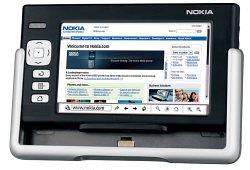
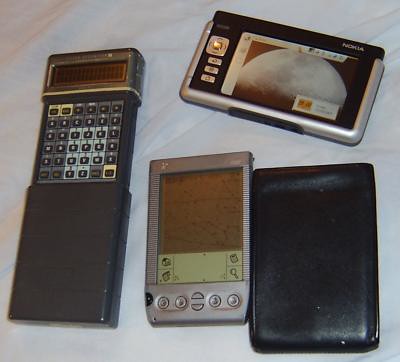
Psion Organiser II, Nokia 770, Handspring Visor PlatinumIn 1987, i picked up two Psion II Organisers. They were really hot when they came out! They look pretty much the same as each other, but one has 32 KB RAM, and the other has 8 KB RAM. RAM is used for file storage too, but internal RAM has some special features. There are two slots for expansion memory for file storage. They come in two flavors. RAM with a watch battery for persistence. And EEPROM. The Psion can write to it. But you can't rewrite. This can be overcome by marking records for deletion. When it becomes full, copy the stuff somewhere else, erase the pack, then copy stuff back to it. This is how you get the space back from deleted files. They also came with an RS-232 serial cable, and you can copy files to a host, like DOS, back and forth. This is how backups are done. The 8 KB system has some limitations. It can't use my 32 KB RAM pack. You must have 4 KB RAM free to use the serial port. They also can make beeping sounds. Pitch and duration are controllable, so i wrote a music program. Sounds like one of those birthday cards that you open and it makes noise. But, you can write your own tunes, with multiple octaves, repeats, etc. The display is two lines of 16 characters. There are user defined characters, giving one almost pixel by pixel control.

The serial port on my 32 KB Psion died. That meant it could no longer be backed up, and i stopped using it for anything more than a calculator. The 8 KB Psion is still nearly pristine. Well, except that dates past 1999 don't work in the calendar. Feh. Bloody Y2K.

These machines have the Hitachi 6303x processor. This chip can access 64 KB of memory. Half of this is ROM, more or less. They run at about 2 MHz. The 9 volt battery lasts a couple months of normal use.

The applications include a calculator, calendar (appointments), notes, file transfer (with special software on the other side) and remote login (can act like a terminal). The units are also programmable. On board, there is a language called OPL. OPL is something like BASIC, but without line numbers, and with block structure. Even after years of not seeing this language, i can read and write these programs without reference to the manuals. There's something to be said for a language that easy. There is also a cross assembler that runs under DOS. I studied the manuals, but never actually wrote anything for it.

So, a comment suggested that my new Nokia 770 is probably much faster. No need to guess. I have benchmark results for both, using benchmarks i started using in 1982. Here are some numbers:

Matrix Multiply
Timex780Machine & Language
0.03083143.2100Athlon 1913 MHz C
12.12007.9900Athlon 1913 MHz Perl 5.8.8
5.159618.7800Nokia 770 C
238.47000.4060Nokia 770 Perl
9.820014.1300Compaq Aero 486sx/25 C
25920.00000.0037PocketC Visor Platinum
612000.00000.0001Psion Organiser IIXP OPL


Sieve
Timex780Machine & Language
0.0602310.2300Athlon 1913 MHz C
19.5707.0900Athlon 1913 MHz Perl
0.896154.7900Nokia 770 C
181.7500.3800Nokia 770 Perl 5.8
278.2140.4490Compaq Aero 486sx/25 C
90744.1330.0014Compaq Aero 486sx/25 Perl*
22135.0000.0063Palm Platinum Cbasic
57000.0000.0020Psion Organiser II OPL


Unfortunately, i don't have Perl benchmark runs for the Aero. I probably hadn't written them yet. I have extrapolated a Sieve Aero time using Athlon times. This doesn't work for the Matrix Multiply, as the 486sx/25 didn't have floating point hardware. But to be fair, i didn't use Perl on it much. No, i really don't have eight significant digits of timing information. I'm just trying to get the decimal points to line up. Benchmarks like this often have a ten percent variance between runs anyway. The Vax 780 was benchmarked in the early 1980's, and was considered by many to be the 1 MIPS (Million Instruction per Second) machine. But since some machines must execute more or fewer instructions to get something done, a more fair comparison is to test some workload.

There are two workloads here. The Matrix Multiply does lots of floating point multiplies and adds, with two dimensional array indexing. The Sieve performs integer comparisons and single dimensional array indexing. Since neither the Palm nor the Psion have floating point hardware, both of these machines perform relatively better at the Sieve than the Matrix Multiply. The Psion CPU doesn't have integer multiply, handy for two dimensional arrays.

But yes. The new Nokia is 300 times faster for the Sieve, and 2,500 times faster for the Matrix Multiply. And yet. Both of these benchmarks are in languages that compile to a virtual machine code, which is then interpreted. Any semi-modern desktop using a real compiler should be 20 million times faster than the Psion. When i get a benchmark run in C on the Nokia (easy enough), i expect a factor of 300 to 400 improvement over the Perl version. And if i manage to shoehorn the matrix multiply into the Nokia's DSP (Digital Signal Processor - a super computer's vector processor of sorts) (and more difficult to accomplish) then the sky's the limit. That's how the Nokia does sound and video, after all. Or, i might run into the short vector lengths (20). To be fair, i haven't attempted this in the Athlon's funky on-chip FPUs or GPU.

A brief note about Perl. Yes, there's a huge performance hit compared with C. But even on the 486sx/25, many applications would be fine. For example, many web based programs would still finish in much under a second, and you'd think it fast. And for some machines, it's not a factor of 300, it's a factor of 1,000. And it's still OK. This still bothers me. Perl 5.8 (and later, i suppose) comes with a Perl compiler, which improves things by a factor of five. I don't see it used much. Another odd thing is how little code i have hanging around written in Perl at home. For the past six years or so, it's been my primary language. But when i want to write something at home, it's nearly always in C.

Thursday, September 27, 2007

Nokia 770

The digitizer on my 2002 vintage Handspring Visor Palm Pilot is crapping out on me. It's functional, but every few seconds, i have to recalibrate the digitizer. Sometimes, it messes up during the recalibration, and it can take five minutes to get through it. It often helps to try twisting the whole device this way and that to get it to work. So, i want to replace it.

Some history. Before getting the Visor, i had a 3.5 pound subnotebook. It could do everything my desktop could do, but with less memory and disk. Further, it could communicate with my desktop fast enough for backups and data sharing. But, it was more expensive than my desktop. When it died, i did without for a number of years. Eventually, i picked up the Visor, and though i lost much of what i'd used the subnotebook for, i started using the Visor for new things that i now depend upon.

One way to replace the Visor is to pick up a cheap Palm. The cheapest $100 Palms have three or four times as much memory, are faster, and have color. What's not to like? Just backup the Visor, restore to a new device, and get on with life. But i'm the type of guy who shops carefully for bananas. This is much more important and expensive than bananas.

The deep dive investigation should take into account the Three P's. Portability, Performance, and Price. If it isn't portable, you won't use it. If it can't do what you want, you won't use it. If you can't afford it, don't buy it. But otherwise, price can be optimized. You might get performance at the sacrifice of portability. That would be the desktop.

I did a wider search for bliss, and discovered that the Nokia 770 (in process of being replaced by the newer, bigger Nokia 800) has been heavily discounted, and appears in my price range. It has some new capability. It combines the functionality of my old subnotebook, but with the portability and applications of an organizer. It runs Linux, like my desktop, though that isn't evident from the casual look. Linux is under the hood, and i can get at it. It has the power and resources to do things even a new Palm won't do. Here's a comparison:

FeatureCompaq AeroVisorNokia 770
Date1995-19992002-20072007+
Display640x480 grey160x160 b/w800x480 color
Data entrykeyboard, mousestylusstylus *
Carry inbrief casepocketpocket
Performance10 MIPS5 MIPS100 MIPS
CommunicationsCable 22 KB/secUSB 100 KB/secUSB or Wireless 1 MB/sec
ProgrammableYesNot reallyYes
Apps usednote pad, planetarium, book reader, calculator, Web GUI-DB backed app development, web browsingnote pad, planetarium, book reader, calculator, calendar, sketch, contacts, music apps.Video clips, photo album,note pad, planetarium, book reader, PDF reader, calculator, calendar, sketch, contacts, music apps, Web GUI-DB backed app development, web browsing
User file store70 MB4 MB192+ MB
Cost$600$110$150 (sale)


While the 770 has a stylus, it also has remote login, as did the subnotebook. But that means that one can use the desktop's keyboard. Further, a wireless bluetooth (or WiFi?) keyboard can be purchased. A USB keyboard might be usable, but the 770 does not have a powered USB port, so a powered hub would be needed. To make it portable, you'd need a battery powered powered USB hub. A bluetooth keyboard would be cheaper and easier. I'll try remote login from the desk first.

In the last months of my Visor, i experimented with various languages for it. Chipmunk Basic is free, but is a crippled version of BASIC, and is slow. Lispme is free, implements a variant of scheme, nearly produces executables that you can hand out (you need to give them the whole environment), the environment is fragile, and the speed isn't very good. There is a free C cross platform compiler that runs under Linux, but what i'm looking for is something i can goof around with on the device. Really, the Visor is too slow to be acceptable for an interpreter. Further, the Visor's one-app-at-a-time execution environment means that the user has to wait for any computation to take place. My best guess is that Quartus Forth is the best language. It's not free, but it produces small standalone executables. Too late.

By contrast, the Nokia 770 has a Perl environment installed when you buy it. That means i can hand out a perl script, and that's it. It will just work. And tiny perl scripts can do alot. There's also a shell, so shell scripts are also possible out of the box. While there is a native C compiler - word on the street says it runs out of resources for non-trivial applications. There is a cross platform C compiler. Python and Ruby can be installed. Further, the processor performance is high enough that a language that does not compile to the native iron, like Perl, Ruby and Python, is acceptable for a large number of applications. Further, since it really multitasks, the user can start a computation, and do something else while waiting.

It's been about a week. So, for example, i haven't tracked down and installed a calendar application. So far, the search has only turned up an app that can't turn on the machine and beep. On the other hand, i haven't even gotten a wireless router set up. How have i gotten anything? Well, one of my neighbors, has an open wireless setup, and cable. Thanks, whoever you are. I've been real happy with it so far. But the real test is how i'll like it over the next few weeks.

The latest news is that it appears that there is a Palm OS emulation application. It may be possible to download my favorite Palm OS apps, and run them on the Nokia.

Tuesday, September 25, 2007

My job is so secret

So, imagine that you have a development cycle where a two line can take six months to make it into production, assuming diligent developers and savy management. By the time the fix gets into place, everyone involved has forgotten what needed fixing. Devlopers have been working in a devlopment environment, where the fix has been around for ages. Testers have to be reminded that it isn't a new bug, and, by the way, the fix is in the pipeline. End users have forgotten that they needed it fixed.

My job is so secret that not even i know what i'm doing.

Wednesday, September 19, 2007

Pirate talk

Pirate flagIt was Talk Like A Pirate Day today. Arrg, mateys, and you can lay to that!

Thursday, September 13, 2007

Dark Energy

I was at the store the other day, and noticed that they now sell disk drives that can hold a terabyte of data. Well, of course they hold more data. The whole Universe is expanding!

Tuesday, September 11, 2007

Queues

The third Rule of Acquisition clearly states, "Never pay more for an Acquisition than you have to", ST:DS9, The Maquis, Part II.

So, large American, Car companies want to save money while conducting their business. Business is complex, and computers can help keep track of things, etc., so they use them. Over time, the Information Technology department becomes rather large and complicated in and of itself, so they look for ways to save money there, too. All this is natural.

One of the issues with computers is that they themselves are rather complex, and require considerable training to use, program and maintain. Good database administrators, programmers, systems administrators, etc., are highly skilled people and therefore are expensive. In general, companies are drawn to organize these people by skill, putting like people into like groups. For example, there's a systems administration group, or a database administration group. A programmer, attempting to write or maintain some application needs to communicate with such a group to make use of such expertise, but also to get access to relevant systems to make needed changes.

As the organization grows, these groups change from technology enablers, to technology gate keepers. They become responsible for systems security, enforcing corporate policies, and so on. To reduce costs, these groups are reduced in size until each person is fully loaded with work. The result is that when a programmer needs to make changes in a system, their request enters a queue, and weeks go by before any action is taken. When mistakes are made, more weeks go by before corrective action is taken. This can be true even for the most trivial of changes, where the programmer had appropriate expertise to make changes, but did not have authority.

And, an honest analysis shows that the body count isn't reduced. It turns out that both the requesting programmers, and the servicing administrators are required to fill out paperwork, perform extra unneeded steps, and real productivity is minimal. The customer has to wait longer, and everyone ends up with more overhead than actual productive work. Far from ensuring quality, mediocrity is enforced. This is not the fault of the individuals.

This tendency to crowd people together by type has long been recognized in industry. The resulting stovepipes generate communications difficulties and pointless overhead. It is not unusual for the overhead to exceed an average of twenty or thirty times the amount of real work, as measured in hours. Worse, much of the overhead is geared to measure progress. Data from these logs are used by managers to show that the system is becoming more efficient, even as latencies grow ever longer. These statistics are, of course, wrong, not just misleading.

Clearly, it's no fun to work in an environment that is mired in bureaucracy. But how does one fix the system? The key is to point out just how terrible the system has become for the end customer. Further, one needs to point out how the head count has grown while productivity has decreased. The evidence clearly shows that small integrated teams, with all the expertise in a tighter nit group are considerably more effective. One needs systems administration, database administration, developers, business liaisons all in one place. If single individuals have competence in more than one area, they are that much more effective. That suggests that small groups control their hardware, systems software, and applications software. Small groups should develop their own standards for backup, source control, coding style and database naming conventions, application deployment, and so on.

Sure, the larger company should have policies, but the development group should be able to treat these as suggestions. If they decide to deviate from company policy, they should be able to do so without a waiver of any kind. Then, the policies will reflect business needs, rather than reflect blind guesses.

What about external requirements, like SOX? These are business requirements, like any other. Let the development group handle them. If they require reporting, then reports become policy or part of the automation, as makes sense. The key is that things should make sense.

Wednesday, August 29, 2007

Thumb loading

I talked about thumb drives a while back. And, i'm at it again, downloading huge amounts of stuff and tossing it onto thumb drives.

Not only does it take awhile to fill a 2 GB kingston, but it also sends the load average through the roof. It's typical to take an otherwise unloaded system from a load of zero to a load of 5. And, it stays there for the duration. What's with that? The CPU is 99.7% idle. So, it's not like parallel ports where the CPU needs to do something every few bytes transfered. What are the other 4 tasks waiting to run? And despite the low CPU load, responsiveness during copies to the USB thumb devices is sluggish and jumpy.

This is under Linux.

Anyone have any idea why? Is it different under Windows? Mac? OS/X?

Tuesday, August 28, 2007

Canoe trip

Ducks on a log

It's late in the season, but the canoe trip experience has finally taken place. We're not talking about a shakeout run to make sure everything works. We're also not talking about days on the water, or some other big deal. But, a trip with passengers. It's taken nearly a month to get it together.

Since we're, at heart, city folk, the trip takes place in a city. The Huron River runs through Ann Arbor, MI. Since it was otherwise quiet and peaceful, we brought along a couple ten year olds to provide continuous noise. The ducks were unable to compete with this noise, and so, stayed quiet themselves.

Gorgeous day. This is, unfortunately, the best picture taken all day. It had to be modified to look even this good. Mallards, i think.

Monday, August 27, 2007

Internal Discipline

bug eyesWhen we last left our hero the large organization was overrun by high latency task groups that were effectively obstacles to progress.

Another feature of large organizations, and by large i mean organizations with more than one person, is externally applied discipline. The problem to be solved is How does one motivate the employee to produce good work?. For the software developer, it's the wrong question.

One of the common management approaches to this problem is characterized by the carrot and stick paradigm. The idea was that to get a horse to pull the buggy, one had a carrot and a stick. The carrot was a reward for good behavior. The stick was punishment for bad behavior. Now, modern management has no experience with horses, or they'd know that the stick was not for punishment. The carrot was suspended by a string from the stick. But that isn't the modern interpretation.

Any parent will note that a promised reward is a much better motivator than punishment for children. In fact, punishment doesn't work very well, and not at all over the long haul.

But managers generally don't think that they have anything to offer an employee (which is false). They also don't think that they can get away with much in the way of punishment (which is also false). So, despite the above very common and widely talked about concept, it often plays almost no actual role in obtaining quality work.

What managers really know how to do is the paper trail. To get the developer to use source control, have a manager sign off that code is in the system. To get the developer to adhere to database standards, have a database administrator approve any database usage or changes. To get the developer to add user level help pages, have someone who only handles installing help pages on the system review the text and install it. To make sure that the customer is satisfied, have the customer sign off on the project before it is placed on the server. Each of these processes adds delays to the project, but do they ensure quality?

No. It turns out that the database administrator doesn't know anything about the application code. So even a simple query that uses only indexed keys might in fact be issued to the database millions of times. Only the developer would know that. The help text manager doesn't really know the application, and can easily miss omissions and outright errors in the text. Worse, help text usually concentrates on the details of how a function works, but never gives the end user any idea why one might want to use the function. That takes context. The customer signs off on the application, but does so at application launch. It may be a month before the customer is familiar enough with the product to be able to really evaluate it.

External discipline is inefficient and ineffective. The solution is to empower the developer to do the right thing. First, the developer should be aware of the kinds of quality that the customer wants. It may be consistency, repeatability, discoverability, ease of use, etc. Second, for those quality issues that only a developer could understand, review should be made by another developer. Code reviews have the side benefit of disseminating knowledge. Even the most senior developers learn something. Involve the database administrators early in the process, not late. The DBA should suggest good ways to do things up front, not stall a project nearing completion. To do that, the developer and the DBA need to work together. For best possible speed, they should be a single person. The customer should be able to give feedback at any time, not just before the launch.

Thursday, August 23, 2007

Empowerment

bug eyesLarge organizations have a problem. It's a hard problem to solve. That is, how do you organize the division of labor when you have a large number of people? It's not a new problem. Sun Tzu's The Art of War covers it. The general was asked, "How large an army can you command?". His answer was "the larger the better". Old problem but solved.

People tend to learn new skills fairly slowly, so it is commonly thought that no one knows how to do everything. In any case, the large organization tends to discover, often by luck, that a person knows how to do some specific task, and then uses them for that one task exclusively. As the organization gets larger, groups of people form to perform specific tasks, and the organization tends to treat these the same as individuals, performing one task forever.

The large organization then takes these task groups and establishes processes that let the groups get things done together. When there is a complaint that the process isn't written down, it tends to get written, and becomes less flexible. When problems of quality arise, and let's face it, humans make mistakes, the reaction is to manage quality by requiring that a high level manager signs off on actions. But these people don't know how to do everything, so they don't know how to judge quality. They become a source of latency for projects, with no added value. Management thinks in terms of paper trails, and requires paper documents for everything.

The ebb and flow of work to do means that some task groups feel overloaded from time to time. They set up often elaborate queues where tasks are submitted, and 'customers' are given a minimum wait to get things done. For example, a database administration group may require a minimum of a week for any task - even if the task requires no analysis, no research, no diagnosis, just a simple command sent to the software. Often, these groups require that there is no face to face or even phone contact, and miscommunications are frequent, requiring resubmission of the task, with attendant latency.

So, let's say you're a developer, and the project is to project a web based application. Checking your source into the source tree requires sign off from the source code control group. Placing the application on the server requires sign off from the hardware and web server software groups. The database administrators need to sign off on the way the database is used, even if there are no new tables. The help text for your application is managed by yet another group. The application took a week to write, but takes an additional six weeks to deploy, if you're lucky.

How can this be fixed? Instead of attempting to manage quality by instituting sign offs by management enforced by restricted access to systems, the trend should be to manage quality by automated paper trails, with automated back-out systems for failure mitigation. The emphasis is on automation to reduce latency. Empower the developer to get things done by giving them the tools needed to get the entire job done. Trust that the developer will attempt to do the right thing, but don't be afraid of failure. Fear of failure causes paralysis.

There are a complicated set of issues. For brevity, this is just one of them.

Monday, August 20, 2007

Troll

Kirk vs Janeway

COBOL vs Java

Miata vs Jeep

Spaceship One vs Shuttle

Meede vs Orion

Discuss

Wednesday, August 15, 2007

Monday, August 06, 2007

Tom Swift

On the way home from Bible Camp, my ten year old son and i listened to a 4 hour book downloaded from Librivox. Tom Swift and the Visitor From Planet X, written by Victor Appleton II. It went over well. There was a cliff hanger every chapter, except the last. This could be serialized on radio easily. 20 Chapters, so they must have only been ten or fifteen minutes each. That's short enough for nearly any attention span.
The reader, Mark Nelson is very good. No memorable mistakes. Maybe there aren't any. He does it with a 1950's style, with gusto, WoWee! But should you want to read it yourself, the full text is available on Gutenberg.

It's science fiction, with an action/adventure feel, but i had difficulty placing just when it might have been written. It has a 1950's style, but seemed to have references to more modern inventions. Fortunately, one doesn't have to guess, since Wikipedia knows it was written in 1961. And, it knows who Victor Appleton II is, and what a busy guy Tom really is. He had something like a hundred such adventures. And those are just the ones that have been written up so far.

The story has it all. Hot sex - well - there was a quick kiss on the cheek. I wasn't paying attention. It might have been Tom's sister. And, it has violence. Well, there was an earthquake, and some property damage. Space aliens, including the Visitor from Planet X. I was hoping the space alien would have something to teach us about global warming or world peace. Not a word. The one named villain turned out to be a spy working for the good guys. In retrospect, it's hard to believe there were 19 cliff hangers.

Monday, July 30, 2007

Canoe

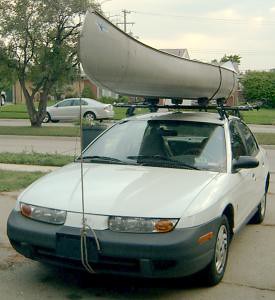
So, the canoe and bike rack was last set up on the previous car. It's a fairly fancy Yakima setup. There are these adapters, and the rack has been on four different cars now. But it had never been on the Saturn, so it was an hour getting it there. There probably is a clip designed for the Saturn, but i was able to make an existing set work. At least it's secure. Well, i didn't do the acid test - drive on the highway. I would have, but the on ramp to i75 south was closed. The primary test wasn't the drive, it was the canoe.

So, the canoe works. You see, there are paddles, and life jackets. A water bottle. Some binoculars. Can't go anywhere without binoculars. And... and that's it. So really, most of the test was getting the canoe onto a car.

With the rack on the car, the next step is to find the key, and unlock the lock which holds the chain. This is easy, since the lock was unlocked just a couple months ago. Except, that the key can't be found anywhere. After a half hour fruitless search, it is decided that one link of the chain can be cut, freeing the lock, and by the way, the canoe. This takes an hour. It's a very good chain (now slightly shorter).

I'd have never designed a canoe rack that has the canoe upright. I mean, when it rains, it fills with water, right? If too much water gets in there, then what do you do? The car could be overloaded, or the canoe might be too heavy to remove. Bail it? So far, though, it just hasn't been a problem. And for some reason, i've never thought to load up the canoe with everything in sight. One can put alot of stuff into a 17 foot canoe.

One nice thing about the rack is that in addition to the canoe, two bicycles can go up there. And, they go up without rubbing against anything. Nothing worse than a bike rack that damages the bikes. Or the car.

The test run for the canoe involves putting it into the water, and paddling around for a couple hours. Elizabeth Park has a nice parking lot, a little channel that goes out to the Detroit River. From there, one gets to deal with wind and waves. My trip took me to the bridge, which swung open to let a large boat through - always exciting.

And, i made it back alive. Mostly. Nothing damaged that can't be cured
with a little wine and a long bath in the hot tub.

Monday, July 23, 2007

Harry Potter Book 7 - no spoilers

I've now read half of the book. The non-spoiler review so far: i like it.
There's not much to say beyond that without giving something away.
So, I'll stop.

Please don't post your spoiler here.
For example, don't flip to the last page and tell me the last word.
Even if that word turns out to be "the" (which is unlikely. I'm not sure
i could construct a sentence that ends with the word "the").

I'm not reading the web until i've finished the book. It could be
a few days. Unfortunately, i have to eat and sleep, too.

Monday, July 02, 2007

iPhone Diet

The new buzz is that one of the women at work got a new iPhone over the weekend. She's been goofing with it, and showing it off, pretty much as one might expect. In fact, lunch got moved back quite a bit. Not just for her, but for many of us.

I'm calling it the iPhone Diet. It can affect those around you, too. And, they don't get to decide if they want to participate. I didn't get to decide, and i don't even want a phone. My angle is more what user interfaces could be adopted for the Palm Pilot.

This isn't a balanced diet. You could get serious malnutrition from it, if prolonged. Fortunately, like most diets, it isn't expected to last.

See also, the Relative Diet, and Zeno's Diet.

Wednesday, June 27, 2007

Bad Weather

We have a thunderstorm, right now, raging outside. I'm glad i closed my windows.

If you closed your windows, how did you post to your blog?

I mean, the windows in my car.

Monday, June 18, 2007

Coolest new app

Well, it's new to me.

sudo apt-get install dict
sudo apt-get install dictd
sudo apt-get install dict-web1913

This gives you a 1913 English dictionary with definitions, from a local dictionary. That means it continues to work even if you are off line. From the command line, this example gives you a definition:

dict synopsis

Friday, June 08, 2007

How fast is your thumb?

My beloved 128 MB Jump drive is lost. Stolen, actually. One of the things that i really liked about it was that the cap really sealed the stuff inside. It survived being left in a pocket and going through the wash. Twice.

My 512 MB Firefly was lost, so i had no thumb drive at all for several weeks. Well, not exactly. My iPod Shuffle is 512 MB (discontinued), and often has 100 MB free, and can be used to transfer arbitrary files too. But, I finally broke down and went to a store. My Jump drive cost something like $35 way back when, and being somewhat short on cash, i wasn't going to spend more than $20. I'd just have to get a small one. In a bin by checkout at MicroCenter, were 2 GB Kingston drives for $15.95. With tax, that's $16.90. So much for settling for a small one.

The Firefly turned up shortly thereafter. Both drives are in use. And something odd turned up. I downloaded interesting audio books from LibriVox, which turned out to be several gigabytes. The Kingston drive seemed to take quite a while to fill compared to the Firefly. Yet, transfer speed at home was much better.

At first, i thought that perhaps the computer at work had an older USB 1.0 interface. That's absurd, though. It's nearly three years younger than my computer at home. And, why would the FireFly be so much quicker? Well, the firefly is a quarter of the size, so maybe that's it. There's no way to get to the bottom of this without some measurements.

It turns out that i'm only writing data at work, and only reading it at home. And the Kingston is nearly nine times slower writing than reading. The Kingston is about 20% faster at reading than the Firefly. But the Firefly is only half as fast writing than reading. So, the Firefly is four times faster writing than the Kingston. And, since it's a quarter the size, filling it takes a 16th of the time.

OK, so the speed of the device is not listed anywhere. Would it be a deal breaker? No. It's quick enough, cheap, and has large tracks of land.

Wednesday, May 30, 2007

Carded

They card you for Nyquil. Perhaps it still has alcohol.

I would not give anyone like this any strange ideas. For example, when crossing the border into Canada (or on the way back to the US), and they ask, Do you have any drugs?, it's probably not such a good idea to say, "Damn. I left them at home. I knew I forgot something!

When crossing the border, and they ask, Do you have any fire arms? It's probably not a good idea to reply, I can get you anything you want.

But let me know when you're going. I'd like to go along and see if they strip search you.

Friday, May 25, 2007

Make Mine a Double

Radio Lab on WNYC is available as a podcast. Season three starts out with a discussion of the Placebo Effect. For example, the doctor tells you that this light blue pill will make you better, and it does. Only, there are no active ingredients in the pill. You got better, at least to some extent, because you thought you'd get better.

Now, you might think that a doctor who gave you a sham pill is a quack. He doesn't know what he's doing. He's selling moon shine - that is, something you could have gotten without him. But the deal is, you actually got better.

And even the medical doctors who have real training, and are backed up with real medicine, put on their white coat and talk to their patients in a way that convinces them that they'll get better.

Now i listened to this show while sick. I stayed home from work. I'm not paid when i stay home, so when i stay home, it means i'm on death's door. And when i only feel terrible, i go back to work. After all, if i'd stay home, i'd feel terrible, and if i go to work, i'll feel terrible. I may as well get paid for it.

I'm not a good salesman. I've mentioned the bagel club. For me, giving out bagels and donuts for free is a hard sell. And, i'm very skeptical. That means the story has to be really good for me to have any chance of believing it. Double blind clinical trials are the gold standard. Pray to Jesus just isn't going to do it. I can't be hypnotized because, well, i don't believe in hypnotism.

So, imagine that i'm cheap. I don't want to go to the doctor for antibiotics. I have an idea how long it will take me to get over things, and, for the most part, antibiotics don't make me well any quicker. But, i do want to get something that will help. What do i do?

Here are my cures for the common cold. Drink lots of water. In fact, drink a gallon of water a day. You can drink more water if it's room temperature. A gallon is alot. It's probably twice as much as you think it is. So keep a full glass in front of you all day. Drink it. Linus Pauling advocated high doses of vitamin C. I've not found that mega dose pills help at all. Nor an orange. But a pink grapefruit seems to help. Eat the whole thing, without sugar. Avoid sugar altogether when ill. Get lots of sleep. As much as you can. Use any trick you can to get to sleep. Lie perfectly still and try not to think. Turn on a boring radio program and close your eyes. Whatever works. Shower. Brush your teeth. Sore throat? Gargle with aspirin. Gargle with salt. Gargle with mouthwash. Gargle with chloraseptic.

I'm not sure that any of these things work. That is, i don't know that they have any external helping ability. But they feel like they work. And, if you do them all day long, you should at least get the placebo effect on and off all day long. And the placebo effect is real. It's real chemicals that your body releases. And there are no side effects. And, in double blind clinical trials, it really works.

It's mind over matter, after all.

Steve Martin said it best: "I'd like one of those new double strength placeboes, please".

Monday, May 21, 2007

Astounding Science Fiction

I'm just a bit behind in my podcast listening queue. At the beginning of April, Escapepod ran their 100th episode. They run short science fiction. The stories are typically under and hour. Episode 100 went slightly more than an hour. However, it was written by the legendary Isaac Asimov. Nightfall. And, it's good story. Many say it's the best ever written. It's not really dated. You might expect that from a story written in 1941. What i will say is this: If you're only going to listen to one science fiction short story, this is the one to try. And, you might just get hooked. Fortunately, the archives go back to the beginning.

Friday, May 18, 2007

Fall Well

So, Jerry Falwell is dead. I've linked to a site with a video of one of the better euolgies. If you don't have a high bandwidth connection for the video, you can at least read the blog. But the video is priceless. I hope when i'm dead, someone has the guts to stand up and say it like it was.

Falwell was pretty much beyond delusional. And now, he's going to burn in hell, contributing to Global Warming.

Tuesday, May 15, 2007

Ten Percent

One estimate of the total number of people that there have ever been on Earth is about 60,000,000,000 (60 billion, or 60 thousand million). There are currently about 6,000,000,000 (6 billion, or 6 thousand million) people alive on Earth. So, ten percent of all people who have ever lived are still alive today. Clearly, the chances of not ever experiencing death is ten percent. This isn't extrapolated from a small sample. This is a one hundred percent sample.
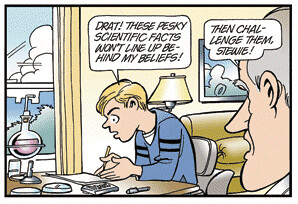
Do you want to live forever?

Sunday, May 13, 2007

At The Deathbed of Darwinism

I've just finished reading At The Deathbed of Darwinism. It's newly available on Project Gutenberg. It was publish in 1904, and was a collection of papers written by E. Dennert, Ph.D. I look at the work from an historic perspective. I'm not an historian, but have interests in how things are figured out, or not. It appears that many great ideas come from people with no significant standing. For an excellent example, see The Reminiscences of an Astronomer, by Simon Newcomb. And, a great many poor ideas come from people who one would think should have known better. This is one of those. It proves that anyone can get a doctorate. If you've wanted a doctorate - go for it. Remember, you heard it first here.

From the title, one might think that Darwinism is just about to vanish from scholarly thought. But over a hundred years have passed, heredity was being discovered, genetics was developed, tons of experimentation has been done, and the essential bits of Darwin's On the Origin of Species is still considered solid truth, more than ever. So what happened?

It's not that easy to pull it out. For one thing, this collection of papers rambles. The translation is excellent. Through it, you can still get the feeling of someone grasping at straws, any straws, to find evidence that supports the author's conclusions. And make no mistake, the conclusions were drawn first. Then the evidence is weighed. And, if the evidence does not support the conclusions, the evidence is downplayed, explained away, outright ignored, or out and out falsified. And pointlessly. But this isn't good science. It's non-science, which can be shortened to nonsense. And this is how the author argues. If it is too hard to argue with a speaker's ideas, then attack the character of the speaker.

The first question to answer is, what motivation does the author have? He spells it out. He considers Darwinism to be an affront, really an attack on Christianity. Why it is such an attack is hard to guess. The author is either silent, misleading or vague on this question. It could be because a literal interpretation of the Bible has God making the Universe in six days about 6,000 years ago. It could be because the author is uncomfortable with being related to apes, or even distantly related to slugs. Some of these things bother people today. They shouldn't. In particular, my own Christianity is completely compatible with the evolution of animals, including humans. It is completely compatible with the origin and evolution of the Universe. And, being related to slugs gives my life a connectedness to life on Earth, and a relationship with the Universe, in all it's glory. The ancient Biblical word translated as "day" could be as easily translated as "era" or "epoch", without a stated length. At that point, it is largely compatible with the Big Bang and Evolution models. And even if it wasn't, Genesis has moral lessons, like the fall from grace, and i never expected a history of the Universe.

The other bit about the book title has to do with the word Darwinism. Christianity is a belief system. The title, Darwinism, is not. One does not say "I believe in Darwinism". One might say, "Darwin's theory of natural selection is a powerful mechanism to explain the evidence". But if extraordinary evidence became available that suggested that Christ never existed, Christians would still be Christians. Yet if extraordinary evidence became available that showed that Darwin was wrong, scientists would drop it like a stone. That's because it isn't a belief system. That said, both Christianity and Science are attempts to learn truth. And truth is truth. Darwin's ideas weren't great because Darwin was a great man. Darwin was a great man because his ideas have stood the test of time.

E. Dennert, Ph.D. attempts to argue that natural selection doesn't work. He embraces all sorts of people who have ideas that might replace this concept. But it should be pointed out that these other ideas also support descent in general. That is, one species changes or branches into another. These ideas simply have other mechanisms. But natural selection, of itself, isn't the idea that is so offensive. Descent is. And this fundamental problem doesn't seem to be noticed in the text. And the flow of the ideas suffers from it. So the author dances around the problem. But in the end, you're left with the feeling that since Darwin introduced descent, he should be punished, and it doesn't matter how.

His first attack is a series of four questions.

1. Is there any evidence that such a struggle for life among mature forms, as Darwin postulates, actually occurs?

Apparently E. Ennert, Ph.D. didn't get out much. My cat ate all the chipmunks, moles, mice, and even rabbits in the neighborhood. Only the Grey Squirrels survived.

2. Can the origin of adaptive structures be explained on the ground of their _utility_ in this struggle?

He seems to argue that if there any features of any organism anywhere that can't be explained, that the theory must be wrong. But Darwin also talked about sexual selection and other factors that are conveniently forgotten.

3. Is there any reason to believe that new species may originate by the accumulation of fluctuating individual variations?

There is now, of course, with genetics, evidence down to the molecular level. But there is also considerable variation in just siblings, available to the author.

4. Does the evidence of the geological record--which, as Huxley observed, is the only direct evidence that can be had in the question of evolution--does this evidence tell for or against the origin of existing species from earlier ones by means of minute gradual modifications?

He uses this question to launch an argument of the gaps. If you have two fossils A and C that differ, then where is the intermediate form? When such a form B has been found, the argument now asks for two new fossils: one between A and B, and one between B and C. But even Darwin suggested that the intermediate forms would be very rare. And rare they are, though certainly non-zero. There is also evidence for speciation among living creatures, plants and animals.

So that's the first ten percent of the book. It continues on in a meandering manner. It continues to using logic that is frustratingly close to correct while consistently missing the mark. It is not much fun to read. I'd much rather read up on a null result experiment.

OK, so E. Ennert, Ph.D. was biased going into the work. And so was i. I owe a considerable amount to Darwin. If Evolution didn't work, then modern antibiotics wouldn't work. Without modern antibiotics, modern surgery wouldn't work. Without modern surgery, when my gall bladder ruptured and became gangrenous, i'd have died a painful death. Clearly, it's time for a prayer of thanks to God for Darwin.

Wednesday, May 09, 2007

Evil


How evil are you?


Mom says i was a perfect child. Apparently, i've grown out of it.

Thursday, April 26, 2007

In Particular

I blamed my cube mate for getting me into the particular habit of using this one particular word to particular excess. When writing a any particular essay, if a particular word is repeated particularly often, i'd look it up in a thesaurus and consider a synonym. When speaking, there's much less editing, and any particular word that comes to mind comes out of the mouth.
But this particular word isn't my cube mate's fault, or at least, not exclusively. It seems to have infected many people. I hear it in podcasts. Live interviews, that is interviews without a script, seem to be filled with this one particular word.

I've not looked it up in a thesaurus. I know a synonym that fills the same purpose. Silence. Read this again, but skip that one word each time it occurs. Does it still make sense?

Friday, April 20, 2007

Guilty

OK, so it's been a year, and i've calmed down. More or less. Last year, the City of Southgate, MI, issued me a speeding ticket. Fort Street is a three lane in both directions boulevard - which is to say that it is divided by a grass median. I pulled onto the street by making a right turn at a light. I then crossed two lanes to get into the left most lane. That's when the bubble lights went on. The officer claimed that he clocked me doing 37 MPH. There were two conflicting problems with this. First was that in the distance i had just traversed from a stop, my car doesn't get up to 37. Second, was that, well, so what? This street has a 45 MPH limit, at least. The fact was, i wasn't pushing it. I had gone to the far left lane because the business that i was to visit had an odd address, suggesting that it was on that side of the street. I'd need to be closer to that side to avoid missing it.

But crossing two lanes of traffic is suspicious. I didn't cut anyone off, or pass anyone, but there was other traffic, and that's that. The officer was not swayed by my story in the slightest.

I wanted a day in court, but when i called the number for the court on the ticket, i was presented with City Hall voice mail hell. There was no entry for the court. I fumbled for a few days, trying to figure out what to do, and realized that the deadline for paying the fine was coming up. Screw it, i'll just pay the fine. Well, they don't accept checks, there's no address to go to to pay in person - which leaves a credit card. That can be done by phone, but for an outrageous surcharge. Perhaps someone better at bureaucracy would not be found guilty as charged with no evidence, and no representation, guilty with no chance to be proven innocent.

I went back to Fort Street, and verified that my car can't accelerate to the speed quoted by the officer in the distance available. I drove around and found that the speed limit is 25 MPH. But in neighboring towns, this same road indeed has 45 MPH and 50 MPH limits, even though the business strip density is identical. So this strip of road has an arbitrarily low speed limit, coupled with high enforcement. I wouldn't call it serving the public, i'd call it milking the public.

There's a clear message that Southgate was sending me, and in the past year, i've taken it to heart. It says, "We don't want your business". I haven't been back. And it is clearly too bad for those businesses. Thousands of dollars lost.

Friday, March 30, 2007

abiword


The modern version of abiword, 2.4.6 could not be installed under Red Hat 9, at least, not without upgrading so many shared libraries that it wouldn't be much like Red Hat 9 anymore. So, shared libraries have prevented me from upgrading my operating system in an incremental manner, preserving my historic functionality. I'm totally forced to upgrade everything, lock, stock and barrel.

I wanted to give the new abiword a try ever since i heard that it now supports tables. Really, word processors don't need the kitchen sink. With tables, abiword has everything i need. One thing i don't need is glacial speed start up times. And, since abiword is so much smaller that OpenOffice, or modern versions of MS Word, it has fast start up times.

So, after spending hours upgrading to Fedora Core 5 (yes, i'm aware that FC6 is out, thank you very much), and then untold hours getting FC5 up to my minimum functionality, i told yum to install the latest abiword. At least this installation wasn't a problem. The install put a link to abiword in the standard applications menu - office. Convenient.

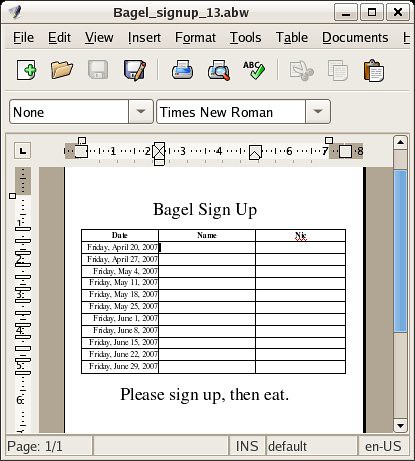
My very first example page for abiword requires a three column table. There's a header in the table at the top, column headings, and some noise at the bottom.

One nice thing, for me anyway, is that abiword let me type in the dates the way i wanted them, without comment. It expects me to know what it is that i want to type, and lets me type it.

This is not what OpenOffice 1.0 did. By default, the table cell format includes "Number Recognition" - which includes dates. So, i type "Friday, 20 April, 2007", and a tab, and the cell then has "04/20/07". What? How do i get my text back? Well, one of the date formats is "Friday, April 20, 2007". It's not what i want. Really, it could be the world standard, but i want the month name to break up the two numbers. Really.

In OpenOffice 2.0, "Number Recognition" is turned off by default. With it off, i can get the format i want by typing it. However, it still attempts to complete the words for me. So, when i've typed "Fri", it adds "day". I don't look at my hands, i look at the screen. So, this brings my 70 words per minute typing to a halt for a second or two while i figure out how to get the rest of the word. It's worse than you might think. The column is right justified, and i want to set that before typing, so that when rows are automatically added to the table, they get the formatting too. So, the text i'm typing dances left and right as the software adds and subtracts it's guess as to what word i'm typing. I usually end up by just finishing typing it. It's quicker than trying to figure out if OpenOffice guessed the right word. The whole thing is so distracting that i feel compelled to perform at least two proof reading checks to see if i've got what i want. I've no idea how to turn off
this "feature".

Back to abiword. In my first printing, the left column printed quite a bit wider than it showed on the screen. Sure, the other two columns are blank, but it's a sign up sheet. You need more room when doing handwriting. That was a wasted output page. So, i selected the columns and formatted them exactly the way i wanted. That worked. I was not able to go back and reproduce the original bug, even with a brand new document. I'll have to watch for it to happen again. But it's not my karma. I generally get to see all the bugs just once.

All software has at least one bug. Every program can be reduced in size by at least one line. Therefore, every program can be reduced to a single line, which is a bug.

I like where abiword is going in functionality and style. It's a keeper.

Thursday, March 22, 2007

Close without Saving


I've recently upgraded from Red Hat 9 Linux to Fedora Core 5. Yes, i'm aware that FC6 is out. This post is about something i've not seen before in over 30 years of computing.

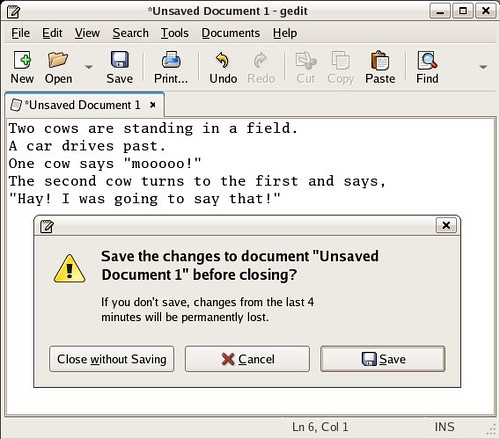
This application is gedit. This is the gnome project's answer to the Window's notepad. Except that it works with large files, and isn't otherwise broken. I don't use it for serious editing because it doesn't do keyboard macros, doesn't have an extension language, and, well, isn't EMACS. But sometimes i need a sort of scrap book of things to copy and paste. So here, i've put some temporary text into a file, and when i was totally done with it, i clicked the X in the upper right to exit. This dialog came up. The new thing is "Close without Saving", which actually says, unambiguously, exactly what it is that i want to do. This is a big improvement over the industry standard.

Tuesday, March 20, 2007

New User Interface

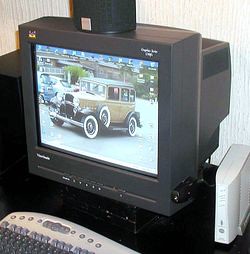
We're patenting a new user interface concept. It's an accelerometer built into your computer monitor. The idea is that when (not if) something goes wrong, and you smack the monitor, that this information can be sent to the computer, which can realized that it has been hit, and start working properly. At present, smacking the monitor is clearly the moral equivalent to shooting the messenger. But current monitors respond just as well as if you shout at the top of your lungs, but the wall is deaf.
Wednesday, March 14, 2007

Passwords

Computer people (that's me) try very hard (sometimes with miserable results) to make software allow people to do things easily. That sometimes makes it easy for people to do things unreliably. If you don't know what you're doing, you still don't know what you're doing.

Security is one of those things you simply have to know. My advise: write all your passwords down on sticky notes and put them on your monitor. Sure, from a security standpoint, this is terrible. Anyone looking over your shoulder (even if your shoulder isn't there) could get into anything you can. But at least you'd know what you're doing.

I mean, are you really going to do what i do? I keep my passwords encrypted on my Palm Pilot. Not only is my Palm backed up, but i have an identical Palm that i periodically restore to. If the Palm is lost, no one will be able to get my passwords. If my Palm breaks (computers are not immortal, and portable computers are particularly mortal), then i can use my backup unit. If both are lost, i can buy a new one, restore to it, and get back on the air. If my backup computer is stolen, i can buy a new computer, restore from my off site backup, buy a Palm, restore to it, and i'm back on the air. When the Universe (Murphy) is out to get you, paranoid is just good sense.
Monday, March 12, 2007

In need

Overheard this morning.

Is there anything else you need?

Yes. I need another hour of sleep. Can you get me one?

I'm new here. Let me check the desk.

Friday, March 09, 2007

Signs In The Sky

If you view my profile, you'll see that i'm older than i look. And, yes, exercise, diet and clean living have made quite a contribution. But you'll also see things that aren't intended.

For example, you'll see Zodiac Year: Dog (bow wow, or some such). This would be the Chinese year. I didn't write that. It was computed (correctly) from my birth date. From Chinese restaurant place mats, i'd long thought that i was a Zodiac Year: Pig (oink, oink). But since there was a full moon within hours of the Winter Solstice in 1958, the Chinese new year (based on a lunar calendar) came fairly late in 1959, at least a week into February. So, it's all gone to the dogs for me. I read a 60+ page pdf on the subject, and that's my best guess. Yet, despite all my calculations, i know little and care even less about Chinese astrology. Even if it was a brown dog year.

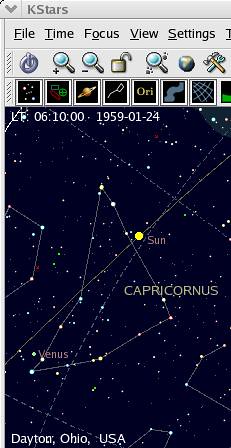
But there is also a bullet point, Astrological Sign: Aquarius. Now most people would say that January 24th makes me Aquarius. But if you examine the above image, the Sun was clearly in Capricornus - so i'm a Capricorn, right? So why does nearly everyone say i'm Aquarius? Well, that's because astrology has been around for a long time, and the Earth has had enough time to move in it's precession of the equinoxes. My guess is that since the changes have been quite slow, astrologers, who basically do what they've been taught, haven't updated the dates for the zodiac signs.

I'm not here to bash BlogSpot for making bogus calculations. I'm not here to bash astrology in it's various forms. My point is really that not everything you read is either correct or even what was intended. In this case, since i lean more towards astronomy than astrology, if you want to know what i think of my birth sign, it just isn't the historic Aquarius answer. Oh, and you'll be hard pressed to convince me that the alignment of the Sun on my birthdate to the arbitrary grouping of stars we call Capricorn has any cosmic significance to me or anyone else.

I normally post this sort of thing on my Live Journal blog, which i've attempted to devote to astronomical humor. But that blog doesn't put my signs in my profile.

Tuesday, March 06, 2007

Book It

As a parent of a ten year old, i have to say that the Book It program is good. There's a real problem getting kids up to the level of reading for enjoyment. That's the point at which the effort required to read is less than the return. Once they're there, getting them to read is no problem, generally. Just put books they'll like in front of them.

Book It did not get my child through this hurdle. The primary incentive was that (mostly) i read to him every day. I read stories that i knew he'd enjoy. Then, on October 11th, 2005 (it was a Tuesday), he crossed it. He went from kicking and screaming to get through five minutes of reading he had to do for school, to reading for six hours at a stretch on his own. This crossing really happened all of a sudden. And he went from hopelessly behind his class to reading over level in a few months. More on that in a bit.

Though the Book It program didn't do it, it did help. And it probably helps get lots of kids through reading for enjoyment. Pizza Hut runs this program. Many schools and parents cooperate by keeping track of what the kids read. At the end of each month, if the child has fulfilled the minimum requirement, they get a coupon for a personal pan pizza.

OK. I recognize that Book It amounts to a "buy one, get one free" sort of deal. He gets his free pizza, but i buy my own. And Pizza Hut doesn't lose money. On the contrary, i probably go there more often than i would without this program. It's still a good idea.

One result is startling. The house was quiet the other day. On a sneak inspection, i quickly opened his door, only to find him reading Shoestrings.

So, Book It has critics. But obesity is not one of my son's problems. And one personal pan pizza a month is not going to make any difference. You may consider pizza to be junk food, but it isn't banned by the South Beach Diet. If pizza has a problem, it's that it tastes good. My spaghetti has this problem too.

So, how do you get a child to read over level? Easy. Once (s)he's reading for enjoyment, put a book in front of them that's slightly over their level that is compelling. For example, Harry Potter. Rowlings deserves all the accolades she's gotten, and more. Six months after really starting to read, he'd read the first five books. Why didn't he read book six? Well, it wasn't out yet.

Having gotten him through reading, i'm now working on arithmetic. He was at the grocery store with me the other day. He wanted yogurt. Sure, it's filled with sugar, and probably isn't the best for him, but i still meter them out at just one per day. The pack of 6 was $2.69. While at the store, i asked him how much each one was. We did the division problem out loud. 6 goes into 26 how many times? 4. What's 6 times 4? 24. What's 26 minus 24? 2. Drop down the nine for what? 29. How many times does 6 go into 29? Five. Five? Oh, sure. He's doing estimates in class. So each yogurt costs how much? 45 cents. How much is Michigan tax? There's no tax on food. Then we bought it. I've edited out the spots where he didn't get to the next step instantly, of course.

Next up is science.

Tuesday, February 20, 2007

Goldberry

I've read The Lord of The Rings twice. And, yes, i've seen the movies. But the other day, i started listening to an unabridged audio production of the work. Just this morning, i've finished Chapter Seven - The House of Tom Bombadil. The chapter is fairly full of Goldberry - the daughter of the river who stays with Tom. Tom fetches nice things for Goldberry. Goldberry and Tom pursue errands for their guests in perfect concert, but without seeming to coordinate. It's a lovely scene.

But all i'd remembered of it was when Tom sang a song and the Willow tree released the hobbits. And, of course, when Tom put the ring on, and nothing happened. Fair Goldberry was lost to memory. Tom's power is evident and remarkable. Goldberry's power is subtle and forgettable.

Of course, the movies cut Tom and Goldberry out altogether. Not even a mention. The hobbit's journey through the Old Forest was cut too. Well, that's to be expected. Tom is not a player in the drama - just a spectator. And books are long, and movie screenplays are short. Something has to go, even for long movies.

So, just now, i'd like to raise a toast to what's-her-nose.

The audio, unlike the book, can really sing. The lyrics have melody.
Ho, Tom Bombadil,
lives his life with what's-her-nose.
Cares for the Forest,
brings his love another rose.
Talks to the hobbits,
engages with the elven folk,
All the time, he laughs and sings,
Every thing's a Merry joke.

And so on...

Friday, February 16, 2007

Ida - an audio book

I like writing reviews, but delayed writing this one. I don't like to write negative reviews, and I'm still not sure if this one will be positive. Well, for one thing, there is the halting problem, and i can't predict how this review will come out before i'm finished with it.

So, the audio book is about 12 hours. However, each of the 32 audio files has an introduction by the author, and, and i hate this word, an outro (outroduction). And here is the first thing i didn't like about the presentation. Timothy apologizes for his Philadelphia accent before you even get to hear him read. Guys - if you're presenting a show, let the audience decide if they like it themselves. Don't make us pity you for being too stupid to get someone else to read your book. Don't go the other way either. It's OK to promote some other work of yours or someone else's, but just avoid it here.

After the first chapter, the introductions also contained a summary of what had gone on before. OK. So maybe the serial was released a chapter a week. Maybe some people can't remember what happened last week. I skipped all the introductions. The guts of the new chapter start after a bit of music, and my iPod was able to get me there in fast forward most of the time. I also skipped the outro's, which is easy enough, since he says that's the end. I don't have to fast forward, i can just skip to the next track. Since i skipped all that material, there was somewhat less than twelve hours of total material for me.

Another odd thing. After the book, Ida, was over, he offers in a single track, his book Balance. Balance is, by comparison, a short story. And, this story takes place well after the story in Ida. Ida is a prequel. It's a backing story to Balance. Like his introduction to Ida, Timothy apologizes for his book Balance. Jeez. For the record, i liked Balance better. As a short story, the pacing was much faster. Remember that reading a book to yourself is something like three times faster than reading it aloud. So, short stories with very fast pacing work better in audio format. And yet, Balance was long enough to give you the idea that several events actually took place. The events in the story were believable. The events were mostly related to each other. No laws of physics were broken in the making of the story.

The worst parts of Ida have to do with laws of physics being broken. They weren't broken like faster than light. They were more like having a character survive an acceleration of ten or twenty thousand miles per hour in a few seconds time. That would be something like 50 G's, minimum. Ouch. A little more explanation could salvage the suspension of disbelief, and oh, by the way, the plot. This suspension of disbelief nearly caused me to quit listening.

It's science fiction. It'd be nice to have someone vet the science by doing some math here and there. It wouldn't take much. Really.

The best part of the story was that there really is a plot. Things happen. Characters interact. Characters are changed by the events. They aren't entirely wooden. The characters are in space. Space is dangerous. So, the danger isn't just believable, it's expected. In fact, the routine spots are the less believable spots. What about cosmic rays? What about coronal mass ejections and other radiation? Dangers abound.

In all, the work had sufficient interest to make it worthwhile. Multi-dimensional characters. Character interaction. Believable responses. You can identify with the characters. Pick favorites and root for them. Suspense. And the end of the story was not simply telegraphed. There were plenty of surprises in the middle. And the flaws - mostly physics gaffs - were nothing so bad as those in typical Hollywood movies. They're mostly fixable.

Is there sex? Yes. Is there violence? Yes. Is there swearing? Yes. Is the swearing pointless? Yes. This story could have been consumable by my ten year old, but because of pointless swearing, it isn't.

By the by. I'm not generally overly fond of critics. For one, they often think, "Oh, i'm a critic, i should criticize." But they're real goal should be to let their audience be able to decide if they would like something. So, you shouldn't care if i liked this work or not. You should only really care if you are now informed enough to decide if you'd like it. You might not care about the laws of physics. You might not care about the plot. But, you do care if it's going to be worth twelve hours of your time.

Friday, February 09, 2007

Relative Diet

This morning's spread at the bagel club here at work is huge. Not just bagels, but Sun Dried Tomato flavored potato chips, Lemon Loaf Cake, Cinnamon Butter Loaf Cake, and Chocolate Fudge Cake, in amazing quantities. Yum.

No money changes hands at this club. You sign up for your spot in the rotation to bring in the goods. I can only imagine that today's excesses are an attempt to become thinner by comparison to one's peers.

See also, Zeno's Diet. The fun never stops.

Wednesday, February 07, 2007

Save As...

foobar.csv may contain features that are not compatible with CSV (Comma delimited). Do you want to keep the workbook in this format?

It makes me tired. First, the file that was opened was foobar.xls, not foobar.csv. foobar.csv is the file that i want to save to, not the source file. foobar.csv doesn't exist yet, and therefore has no features of any kind. Second, foobar.xls will continue to exist after the Save As... is over. So, no information has any possibility of being lost. As the savvy computer user, the dialog is an annoyance. To the novice, though, it's probably a nightmare. No wonder many novice computer users are terrified.

As it happens, what i want is the data. I'm going to alter it with a text editor. Then, i'm going to stuff it into a relational database. If there is some 'feature' associated with this data, i clearly don't want it. For that matter, the file is just data. Any 'feature' is something programmed into some receiving application. That might be Excel, but probably isn't.

This isn't a problem confined to Excel. It's also MS Word, Open Office, and many other applications. It's the status quo. A poor standard.

Let's take a Word example. I've got a file in Word_5_for_the_Mac. I'm decommissioning my 1987 Mac II, and want to convert my old documents to something a modern word processor can use. The modern word processors don't read Word_5_for_the_Mac format anymore. So, i bring each document up and do a Save As... in RTF format. Now, Microsoft invented Rich Text Format (sometimes also called Interchange Format) for just this reason. But, true to form, on each save, one gets a dialog similar to the above.

Now, only Word could possibly know what features the document is really using. Only Word could possibly check to see if these features exist in RTF. My experience has been that RTF seems to be able to preserve all formatting, pictures, etc., and nothing is ever lost. But if something could be lost, Word could check, right? Why doesn't it?

I have an answer to this question. It's pretty cynical. Microsoft (or whoever invented this dialog) wants to discourage you from exporting your data. They want you locked into using their applications.

Well, here's a hint. If you want my business, you'll have to stop changing your native formats. I've been blessed by not having to change formats for twenty years. Some of these documents have at least forty more years of life left in them (assuming i do). So, their next stop is some open source format, where, in principal, i will be able to support the format forever (or forty years, whichever comes first).

Monday, January 29, 2007

What life must be like at Micros~1

Nothing is better than complete happiness.

A buggy application is better than nothing.

Therefore, a buggy application is better than complete happiness.

Wednesday, January 24, 2007

White Birthday

It's snowing in Michigan today. We've had erratic snow this season. Not yet enough to shovel. Yet the first snow was before Halloween. None at all for Christmas. If i'd wanted this, i'd have moved to Texas. Call it Global Warming.

But today was my birthday. So, it's a White Birthday.

I got a card by email. It's a Word Document. You can tell, because the names "signed" on the card are underlined in red and green squiggles. That's right. They don't know how to spell their own names, or use proper English grammar, at least according to Micros~1. It shows a cake with candles. Eight candles. Well, that matches my avatar. But in the upper right hand corner was the date. It says January 24, 1007.

I pointed it out to the sender (email is really cheap). It's not your normal It's still 2006 sort of error. It suggests that i'm a millennium old today. (It doesn't really feel like it yet. I guess each candle represents 125 years.). They said that i look good for my age.

Now then. Do you ever hear people say You look thin for your height!. I didn't think so.

This one i heard from a complete stranger just out of the blue: "That's your son? He doesn't look anything like you!". Well he doesn't. It's not an issue for me, but this person couldn't possibly have known that at the time. And people say that Midwesterners are so polite...

Today's music: Happy Birthday, by Weird Al Yankovic. 1983. Still rocks.

Tuesday, January 23, 2007

soda can return blues

I'm seeing red because my grocery store no long accepts my soda brand for bottle returns. The trouble is, the vending machine doesn't do returns at all.

Now all this is according to the law. And, i could see it, if the bottles had to go back to the bottling plant. But they don't. Once they're counted, they're crushed and sent somewhere for recycling. They are NOT refilled.

But it's worse. My brand is Mug Root Beer. It's caffeine free. I've had to go that route because caffeine gives me arthritis. I didn't really want to give up my addiction. Really. But Mug Root Beer is Pepsi. My grocery store carries Pepsi, just not this model.

Feh.

Friday, January 05, 2007

There Are No Absolute Truths

The idea that absolute calorie intake minus calories expended is meaningful is simply wrong. I have two examples where this failed.

I met a woman years ago who was grossly overweight. About five feet tall, and over four hundred pounds. She looked for a diet where she could maintain her weight. She gained weight on a 700 calorie diet. She was quite active, and, no, evidence suggests that she did not cheat. Finally, she was able to maintain her weight on a 500 calorie diet. Once stable for a year, she underwent surgery to remove some 190 pounds. Still a bit chubby. Most people would not survive long term on 500 calories.

When i was in school, i ran cross country. My workouts were 15 miles, twice a day. That's 30 miles a day. 210 miles a week. 14 weeks. My calorie intake was not measured precisely, but did not increase. It was probably around 2500 calories. According to Dr. Cooper, my calorie expenditure was over 4000 calories per day. I should have lost weight, right? The actual result was a 10 pound weight gain.

One reason my intake did not increase was that i could not afford to eat more. The caffeteria provided "all you can eat", but my runs ran into both breakfast and dinner. The result was that they closed just a minute or two after i arrived, every day. So, no seconds.

Absolute calorie figures do not seem to understand how physiology really works. One summer, i decided to bicycle to work. (My new job had showers). When i started, my average speed was under ten miles per hour. At the end of the summer my average speed was 21 miles per hour. At these speeds, drag increases with the cube of the speed. So, a doubling in speed requires an eight fold increase in power. To achieve this, one's cardiovascular system needs to adapt. It does this by increasing efficiency and by increasing capacity. But base efficiency of physiology across a population behaves with a bell curve distribution. There are going to be outliers, like the woman i met above.

What does work is relative lifestyle changes. Eat a little less. Exercise a little more.

These aren't many data points, but in the grand tradition of physics, i'm more than willing to fit a ninth order polynomial to them.

Remember, there's an exception to every rule. Even this one.

Wednesday, January 03, 2007

New Year's Resolutions

Rather than report this year's resolutions, i'd rather report on how last year's resolutions came out.

My exercise program averaged at least 20 minutes three times a week from January through August. In September, i caught a cold, and averaged once a month through the end of the year. I'm nearly over the cold. I took it easy over the holidays and feel much better.

My diet was, in my opinion, a failure. While i did not have any net weight gain, there was no weight loss. The goal was to loose 35 pounds. I've done this before, so i know it's possible.

My brain exercises program continues on track. Lots of books read. Several other interests moved forward.

There were no financial goals, and none achieved by chance. Maybe next year.

Tuesday, January 02, 2007

Re-use, recycle

Anyone want a like-new calendar?

January 2006
Su Mo Tu We Th Fr Sa
1 2 3 4 5 6 7
8 9 10 11 12 13 14
15 16 17 18 19 20 21
22 23 24 25 26 27 28
29 30 31

If you're a pack rat like me and never throw anything out, what you need to rummage for is a 1995 calendar. Both 2007 and 1995 start on Monday. Now, if, like me, you throw things out after ten years if you haven't used them, then you may as well toss the 2006 calendar. You won't be able to get more calendar mileage from it until 2017, and of course, you'll have tossed it in 2016. You see, 2012 starts on a Sunday, just like 2006. But 2012 is a leap year. February will have 29 days in 2012, whereas 2006's February had 28 days (unless it really had 29, and i somehow missed it).

Remember this for next year too. Since 2012 starts on a Sunday, and is a leap year, 2013 starts on Tuesday - skipping out on the Monday starting year. You must wait until 2018 to reuse the 2007 calendars, and, of course, you'll have just thrown them out.

Just to get you going for the new year, here's how it starts:

January 2007
Su Mo Tu We Th Fr Sa
1 2 3 4 5 6
7 8 9 10 11 12 13
14 15 16 17 18 19 20
21 22 23 24 25 26 27
28 29 30 31

Happy New Year.

Friday, December 22, 2006

Rob a bank

I met a guy who robbed a bank. Uhm, before he robbed the bank. Uhm, i guess i should say attempted to rob a bank. He had a partner.

On the surface, the plan sucked. There was no real getaway plan. That is, the bank was in downtown Philadelphia, where driving is difficult. It was rush hour at that. This particular bank was nowhere near public transit. They didn't have bicycles. They weren't in good running condition. They didn't have a pre-written note, and scribbled one as they walked in. They stood in line to see a teller. When they handed the teller the note, the teller couldn't read it, and they had to explain what it said out loud - attracting attention of other tellers. A couple minutes into this exchange, a foot policeman walked in. This is even before the silent alarm was tripped. So, they were caught. At least they didn't have any real weapons.

Now, as i said, i'd met this man before. He'd done some dumb things, like get hooked on alcohol, and likely drugs. And, in fact, about this time, both he and his partner in crime had just been evicted from their respective apartments. Probably for non-payment. But, this guy did not seem totally stupid. He could perform logic, and such, and was less delusional than most of my historic managers.

And, it was not that he didn't understand the consequences. He'd been in jail before. His partner too. So, it would be easy to classify them as repeat offenders.

But it was winter in Philadelphia. And these guys had been in homeless shelters before too. Jail was just better. Warmer. Better food. Health care. Less access to drugs and alcohol.

Better.

Merry Christmas.

Monday, December 11, 2006

The Road to Salvation

More on having just read the Christian Bible.

So, what's my goal? Oddly enough, it isn't salvation. For me, chasing after personal salvation is too self centered. It's all, "I WANT", or mindless personal comfort, and seems to miss the point entirely. (Many of my close personal Jewish friends seem to understand this. And it's a good thing to get a glimpse at that understanding.) If i achieve salvation, it will be as a side effect of the life i lead. That's assuming salvation is achievable. And this is by no means certain.

So, what's next in my road to spiritual growth? Well, i may go back and read the other bits using the WEB version. Or, i may start again, but use biblical commentaries, compiled by biblical scholars. It's very likely that these people have historical context information to add that i don't. Why not leverage their hard work?

For example, i once heard an interpretation of the parable of the Good Samaritan, found in Luke. In the story, a priest walks by the hurt person, who was presumed dead. Without context, it sounds like this person is a hypocrite. But under Levitican law, such a priest is not allowed to touch the body of a dead person except that of a very close relative. So, this person acted properly in context. My reading of Leviticus didn't make this obvious to me. But someone who really studied it would know. Does this dramatically change the story? Maybe not. But it does make the story believable to the original audience. But another thing the Biblical scholars would tell me is who, exactly, are the Samaritans? Well, these people were Jews who set up a new city on another hill. Now, cities need serious support. So, these people called their city a holy city. But, to the Jews, Jerusalem was The Holy City. So, those who supported Jerusalem considered the Jews who supported this other city as the lowest kind of creature on Earth. They despised them even more than any non-Jew. This changes the story entirely. It means that the person who clearly acted selflessly and honorably was a member of the worst scum of the Earth. And, this clearly reflected poorly on those who considered themselves the most righteous. So, the story was carefully crafted to make people take ownership of these issues, in no uncertain terms. Yet, due to the ravages of time, there is much that is uncertain or missleading.

Perhaps it is time for modern parables. For example, on an airplane, the steward(ess) says, "In the event of an emergency, oxygen masks will drop down from the ceiling. Place your own mask on your face before assisting others.". This little statement is the same as "before you remove the speck in your brother's eye, remove the log that is in your own eye." Perhaps the modern version will resonate with people in modern culture better.

I'm not quite sure when i started this Bible reading project. And there was a year or two where i paused because my Palm Pilot was nearly unusable. I fixed it, and continued. Probably three years total time. But, i've read more than a hundred other books in the mean time. I've also watched movies, and was otherwise properly entertained. The years go by quickly. So, my advise, start reading. In this, the end goal of finishing is not the important part. Don't worry about it. It's what you get out of the process of going through it that matters.

Sunday, December 10, 2006

Why Read the Bible

More reflection after having just read the entire Christian Bible.

For most of my life i've gone to church on Sunday. So i've heard the entire lectionary series several times. I've also read certain whole Bible books before, like Luke, and the first five books - Genesis, Exodus, Leviticus, Numbers and Deuteronomy. So, much of the reading was review. Certainly, i'd had exposure to most of the good bits. By "good", i mean meaningful and relevant. But reading the Bible from end to end provides context. This context was often startling. Even whole chapters used in the Lectionary seemed to have new direction in context. Certainly, just about any quoted verse you may have heard has new meaning in context. More than half of the time, when someone quotes a Bible verse at you, it doesn't mean anything like what it sounds. It's almost as if someone who took the time to read the whole Bible purposely found verses that, when taken out of context, seemed to mean whatever they wanted to say. That then gives an authority to whatever they wanted to say that simply isn't justified. It is dishonest. And, that's despite repeated admonitions in the Bible against hypocrisy.

Take, for example, John 3:16. This is the canonical Christian statement of faith. It is generally taken to mean what it says. But the book of John does not read anything like the other synoptic Gospels, Matthew, Mark and Luke. And it is worth knowing what John's view is. Without that context, any interpretation of basic Christian faith may be wrong.

I doubt that more than a percent or two of Christians have read the Bible from end to end. Without this background, one is essentially biblically illiterate. And, while John 3:16 says that faith is all you need, consider that "faith without works is dead" (which also requires context to understand), and "the road to salvation is narrow, like the razor's edge", and "many are called, but few are chosen". These references lead one to the idea that salvation, if that's your goal, requires more work than going to church once a week. In particular, going to church once a week does not make you Christian. It isn't enough.

And how could it be? In a typical Christian sermon, the pastor must assume a fairly introductory level of knowledge. There might be new people in the church. Hopefully there are. After all, the primary goal of the church is outreach. But that means that real depth is essentially impossible. On top of that, the typical sermon has just three points. That's 150 points a year, and less if you look for duplicates. Even education programs outside of the Church service have to start somewhere. I've not seen a church anywhere that supports a ten year study, for example.

Now, i'm not going to say that you are Damned to Hell if you don't follow my lead here. Only God judges. I'm not even allowed to judge myself. Perhaps i'm being to hard on myself. Or not hard enough. Yet i don't worry, in fear that i don't measure up. I'm just attempting to do the best i can. No one can ask for more. And as near as i can tell, not even God asks more.

Oddly, if you're not Christian, but just want to understand Christians, reading the Bible won't do it for you. That's because most Christians haven't read it, or at least don't act as if they've read it.

Saturday, December 09, 2006

Reading the Entire Bible

I recently finished reading the Christian Bible. I'm not saying this to brag. Finishing it is very much not the point. I'll expand on this idea in a later post. I'd have read it sooner, but it is a rather large book, and it's inconvenient to carry around. Historically, one got the choice of a large physical book, or really small print. Really small print was an option when i was younger, i suppose. And also, Post-It notes hadn't been invented. (These make excellent book marks, showing not just the page, but the exact spot where one left off).

Another practical problem is that the language of the Bible is not modern American English. Even if the translation is modern, terms and idioms are used that either aren't common in every day use, or mean different things. Maybe it's something simple as "Adam knew Eve". The biblical writers also often meant more than one thing when they wrote anything. So, let's say the bible explained the "Adam knew Eve" bit by saying "Of course he did. They hung around together all the time!". That would be ambiguous too. And the Bible writer would probably mean both obvious things.

All this adds up to slow reading. It's easy to get information overflow, so you have to take your time. Read a little at a time, on a regular basis, like daily. One needs to go slow enough to give it time to sink in, but fast enough so one still remembers the context. That's why Christan educators always suggest study on a regular basis. And even so, the book of Revelation is just impossible.

I solved many of these practical problems by reading the Bible on my Palm Pilot. The entire Bible can be stored on one. In fact, the King James Bible will fit (compressed) on a single 3.5" floppy disk - less than 1.44 MB. If you get the right reader, the Palm can display text in a fairly large font with high contrast. The Palm itself is fairly small, and can do other things than allow you to read this one book. For example, it can keep your phone numbers, addresses, appointments, grocery lists, notes, and for me, a chart of the night sky and observation log. When you are done reading for a session, the Palm automatically remembers exactly where you were.

Reading the Bible on the Palm raises a new problem, however. Copyright. The King James Bible is in the public domain. I can do anything i want with it. It isn't modern American English. I started reading the King James version because it was the only version that i knew was public at the time. Part way through the Old Testament, i switched to the Douay-Rheims version, which had been posted to Project Gutenberg. This version uses slightly more modern English, and has some "extra" Catholic books. More recently, the WEB - the World English Bible was posted on Project Gutenberg. This is a much more modern English version, and has some minor commentary on some specific translation issues. It is my current favorite public domain version.

In my opinion, all versions of the Bible should be public. Sure, making a Bible translation is time consuming and expensive. Christian organizations should eat the cost. I mean, the Christian imperative is the Great Commission - teach all nations. The Great Commission does not say you must keep tight control over the Bible. Nor does it say you must make great steaming gobs of money with this best-seller. They can still make paper editions available, and charge for it. But getting the Bible out in electronic form can allow a wide audience to customize the experience. This can be a make-or-break difference, as it was for me. So, there's no excuse.

While i have a license to an electronic copy of the New Revised Standard Version, a very modern and readable translation, the license does not allow me to do whatever i want with it. So despite having paid more for it than all the paper Bibles i own combined, i was not able to put it on my Palm Pilot and just read it. It's stuck on the computer i bought it for, and that's that. That makes it good for certain reference uses, and only when i'm at home, and the computer (now 19 years old) is working. I also have a paper copy of this version. It's in very good condition, which just shows that i've hardly used it.

Reading the Bible on a computer may not be for you. Maybe paper is for you. I'm just relating what worked for me. Now that i've read it, i may put a new copy on my Palm, optimized for looking up references. Or maybe not. The main thing that seems to be good for is refuting Bible thumpers who hit you over the head with a verse out of context. While it may be fun to argue, these people are seldom convinced of anything, and more heat than light is generated.

Thursday, December 07, 2006

Christmas Coping

Many people get aggravated at Christmas time. Here are some things i do to cope.

My Christmas tree doesn't go up until the weekend before Christmas. I leave the season of Advent for Advent. The tree stays up for two weeks. It stays up for the 12 Days of Christmas (though where this particular tradition comes from is beyond me). Two weeks lets me take it down on a weekend. I have no outside ornaments. It's a fake tree, and so it's the same one every year. The lights are only on from about sunset to about 9 pm. I'm not contributing to significant light pollution. I'm not consuming mass quantities of electricity.

Last year, i wasn't home much over this Christmas period. We spent the time at my mother-in-law's. So, no tree at home at all.

The hustle and bustle of buying presents has been diminished dramatically in my greater family. By mutual consent, we only give gifts to children. So, i'm not wondering what to get adults who already have everything they want, since, if they wanted something, they could certainly just buy it. And, they'd get the exact thing they wanted, rather than just more or less the thing they wanted.

All of this has taken the pressure off of the season, and has made it much more pleasant. My favorite Christmas music is now 'Jingle Bells' - which is about winter. This shouldn't be offensive to anyone. Unless, you've heard it way too much. My solution is to avoid listening to the radio, and do minimal shopping at stores. The Internet lets me shop in a quicker, more fuel efficient manner, and the stuff appears at my doorstep. My iPod only knows how to play things i want to hear. This year, i've learned to play Jingle Bells on the violin. There's a minimal sense of accomplishment, which is better than nothing.

When traffic is slow because of a little snow, i put a little more space between myself and others, and limit my speed against the conditions (can i stop in time?). If it takes a little longer, that just means i get to hear another podcast. This lets me enjoy the snow.

Your life is in your hands. You can do it with a hostile attitude, but there's no value-add.

Friday, December 01, 2006

Zeno's Diet

I run the bagel club at work. It wasn't my idea. No money changes hands. A sign up sheet gets people to enter the rotation to bring them in. Donuts and bagels once a week.

This club is entirely optional. With my sales skills, it is amazing that there are any members. I mean, i can't even give away great stuff.

So, some of the members are weight conscious. So, they come up and cut a donut in half, and eat just that. Then, a bit later, they come back and cut the half in half, taking a quarter. Then, sometimes, even the quarter is cut in half, leaving an eighth.

This is Zeno's Diet. The idea is that before you can eat the whole donut, you must first eat half of it. And before you can eat the remaining half of it, you must eat half of that half, which is a quarter of it. And so on. Since there are an infinite number of steps, it is impossible to finish eating a whole donut. That's because it is impossible to do an infinite number of things in finite time.