In the 80's, i read Robert Silverberg's Gilgamesh the King. This is a novelization of the epic poem. I loved it. To be honest, i hadn't been turned on very much by Silverberg's other works, though my friends like him. Pick up a copy. Amazon is showing it for 2 cents. What's with that? You must have to pay shipping, at least. It's a must-read.
Author Stephen Mitchell has written a modern verse english version of the epic tale of Gilgamesh, entitled Gilgamesh. Kind of an odd thing. I'm pretty sure that i downloaded it from Librivox, but there is no sign of it there now. Perhaps it was mistakenly published there. It is available from LearnOutLoud for about $20. The book is narrated by George Guidall, who has the perfect voice for this work, and provides a competent reading of the book and Stephen's analysis and notes. It is published on four CDs, but takes a bit over three hours.
The book itself is on two CDs. When i reached the end of the book, it was announced that the rest of it was commentary by the author. I thought i'd skip it. I thought of the main book as very short. Silverberg's novel is, well, a full length novel. That should be some eight hours of audio. Yet it was about two. Though i liked it, i thought that the commentary would completely bore me. I know the story. What is he likely to add to it?
And yet, there it was. After a few days, i stuffed the first hour onto my iPod, for consumption on the way to work. If it was terrible, i could always skip to my next podcast. So, it starts out a bit slow, picking apart the details of the story. But instead of basically repeating what was already in the story, he provides insight on why the original author used the structure that was used, why the original author picked the perspective that was used, what the inuendo means and doesn't mean.
OK, so here's where i'm coming from. If you launch an application, say Microsoft Word. But, really, any application will do. Turn on context sensitive help, and point at something, and read what it says. In MS Word, it's under the Help menu, and it reads "What's This". Point it at the icon that vaguely looks like a floppy. It will say something like Saves the active file with it's current file name, location, and file format. Nothing wrong with that, right? Except that it says nothing about why you might want to do such a thing. For Save that is perhaps, not a big deal. But for many more complicated functions, it's everything, and the online help is useless. But Stephen Mitchell's commentary on Gilgamesh covers exactly the why do we care? ideas. It's really very good. It's written by someone who has really thought about it.
Ok, so the book is short, and there's an equal length commentary. It some ways, it's a Reader's Digest or Cliff's Notes version of the epic. Not that i read either Reader's Digest or Cliff's Notes. But in other ways, the work is an attempt to create a translation that captures the spirit of the original. Not easy to do for a work in a dead language. Even if one stands in the footsteps of giants.
(If I have not seen further, it is because I stand in the footsteps of giants. - a wonderful misquote of Newton.)
Thursday, November 29, 2007


Wednesday, November 28, 2007
Extracts from Adam’s Diary
I recently listened to Extracts from Adam’s Diary, a Mark Twain piece read on Librivox, and available for free download. The work is short. There are five chapters, the longest is about six minutes. It's a good quality recording, and read competently. Twain has sharp wit, and this somewhat masks the points he also manages to insert into this short story. If Genesis read this way, more people would understand it.
I particularly liked it, partly because it happens to be a bit of Twain i'd never read before. I've read alot of Twain, so this is becoming more rare. I have read Twain's Letters from Earth, which also has a Biblical bent. But where Twain didn't release Letters, probably because he wasn't satisfied with it, he did release Extracts. Letters starts out sharper, but soon runs out of good material, and drifts from focus. Extracts maintains focus and reaches a conclusion.
It's funny. It's a very consumable sound bite. What are you waiting for?
I particularly liked it, partly because it happens to be a bit of Twain i'd never read before. I've read alot of Twain, so this is becoming more rare. I have read Twain's Letters from Earth, which also has a Biblical bent. But where Twain didn't release Letters, probably because he wasn't satisfied with it, he did release Extracts. Letters starts out sharper, but soon runs out of good material, and drifts from focus. Extracts maintains focus and reaches a conclusion.
It's funny. It's a very consumable sound bite. What are you waiting for?
Tuesday, November 27, 2007
Reading books
Ars has an article about how reading ebooks is not like reading books. The article tries to make the point that somehow paper books are better. Or at least, something is lost going to a non-paper form. I'd say we've gotten to the point where this is moot. In particular, there's an image of a book in the article. Guess what? I read the article in a browser. I could have done this on a portable browser. I get the full artwork. It's also a special case.
I have a 2002 vintage Visor Platinum. If fits in my shirt pocket. It has a monochrome LCD with backlight. It works well in full sunlight, and pitch dark. There is a twilight where the backlight isn't strong enough which is pretty awful. This situation doesn't come up often. It runs on twin AAA batteries, which last, with modern rechargables from the grocery store, about 20 hours per charge. I can carry spares, for longer life. The device life in not limited by batteries. It has 8 MB memory (RAM/file store), enough for several books. The Bible is 1.44 MB compressed. It cost $110 when new. I bought two of them. One loads new books on it via USB or serial.
Until recently, i used it to read books, using the freeware weasel reader. It reads Palm doc books, and also it's own zlib compressed text format. It's own format has bookmarks that can be prebuilt for chapters, etc. There is a utility that will create this format from Gutenberg books, for example. It has two usable fonts - small and large bold. It allows bookmarking and annotating. It remembers where you were in a book. So you can always annotate using some other Palm application, like creating a memo.
I never annotated real books - postit notes hadn't been invented, and i never got into that habit. I don't write in books. But with electronic books, i'll spot an error, and put together a 'diff file' and send it to Gutenberg. My changes tend to make it into the archive, and i'm encouraged to continue doing this. Electronic books are interactive for me in a seriously real way.
There are only a few books i've read more than once. The Harry Potter series, and The Lord of the Rings, for example. But also, from Gutenberg, Reddy Fox. I've read this one maybe five times, out loud. It's incredibly hard to proof read, and i found errors even in the 5th reading (using a text will all my previous corrections applied). Most errors will go unnoticed, but i hope i've helped improve the quality of the work.
I read about 50 books a year. I read about 35, and listen to another 15. It takes a long time to get through 1,000 books. Having alot of books makes sense primarily for reference.
The Visor is an excellent book reader for me. The battery life is long. The device is highly portable. It's main drawbacks are that it is no longer sold - so it can't be replaced, the digitizer is fragile, and it will eventually break, it was basically incapable of showing pictures, it was limited to plain text - no bold, italics, etc.
Now, I have a a Nokia 770. It was about $150 new (sort of closeout). It is the same physical size as the Palm. It has an internal (but replacable) rechargable battery which lasts about 5 hours. That's enough for a commute. One loads data on it via USB or WiFi. The screen is high resolution color. I have 2 GB of file store, enough for a small library. FBReader is available for it, which can read plain text, html (but it is NOT a web browser, in particular, it doesn't seem to let you follow links, so books should be one huge file). FBReader can read compressed files. But with 2 GB of space, this isn't much of an issue. FBReader lets me pick colors for text and background, as well as font and size, so i can customize the experience to the lighting conditions. I read alot in the dark. HTML books, such as A Christmas Carol on Gutenberg, have a few images, and FBReader displays them extraordinarily well on the 770. FBReader also lets you flip between books easily.
The 770 also has a real web browser (Opera) which allows me to read some web based books better. It also allows me to surf the web, read web comics, etc.
The 770 also has a PDF reader. I don't like PDF for online books. I much prefer a format where i can increase (or decrease) the font size, and have the machine rewrap the text to match the screen size. The PDF format is not very flexible. PDF's which have been formatted for two columns on 8.5x11 paper work better than those with one wide chunk of text. But on the 770, i'll make it work if the content is worth it.
With several book readers available, i find that i'm reading several books at a time. Two or three in FBReader, three or four in a web browser, and typically one or two in PDF.
The 770 can play music. I don't generally listen while reading. If it turns out that playing music consumes the reader's batteries, one could use an appropriate dedicated mp3 player. My iPod lasts about 18 hours on a charge. Other mp3 players use AAA batteries, and a pocketful will last weeks of continuous use.
I don't currently commute to work hands free. When i did, it was about an hour each way. I have used a laptop during the commute, and four hours endurance was fine. I could (but didn't) recharge at work.
I have a 2002 vintage Visor Platinum. If fits in my shirt pocket. It has a monochrome LCD with backlight. It works well in full sunlight, and pitch dark. There is a twilight where the backlight isn't strong enough which is pretty awful. This situation doesn't come up often. It runs on twin AAA batteries, which last, with modern rechargables from the grocery store, about 20 hours per charge. I can carry spares, for longer life. The device life in not limited by batteries. It has 8 MB memory (RAM/file store), enough for several books. The Bible is 1.44 MB compressed. It cost $110 when new. I bought two of them. One loads new books on it via USB or serial.
Until recently, i used it to read books, using the freeware weasel reader. It reads Palm doc books, and also it's own zlib compressed text format. It's own format has bookmarks that can be prebuilt for chapters, etc. There is a utility that will create this format from Gutenberg books, for example. It has two usable fonts - small and large bold. It allows bookmarking and annotating. It remembers where you were in a book. So you can always annotate using some other Palm application, like creating a memo.
I never annotated real books - postit notes hadn't been invented, and i never got into that habit. I don't write in books. But with electronic books, i'll spot an error, and put together a 'diff file' and send it to Gutenberg. My changes tend to make it into the archive, and i'm encouraged to continue doing this. Electronic books are interactive for me in a seriously real way.
There are only a few books i've read more than once. The Harry Potter series, and The Lord of the Rings, for example. But also, from Gutenberg, Reddy Fox. I've read this one maybe five times, out loud. It's incredibly hard to proof read, and i found errors even in the 5th reading (using a text will all my previous corrections applied). Most errors will go unnoticed, but i hope i've helped improve the quality of the work.
I read about 50 books a year. I read about 35, and listen to another 15. It takes a long time to get through 1,000 books. Having alot of books makes sense primarily for reference.
The Visor is an excellent book reader for me. The battery life is long. The device is highly portable. It's main drawbacks are that it is no longer sold - so it can't be replaced, the digitizer is fragile, and it will eventually break, it was basically incapable of showing pictures, it was limited to plain text - no bold, italics, etc.
Now, I have a a Nokia 770. It was about $150 new (sort of closeout). It is the same physical size as the Palm. It has an internal (but replacable) rechargable battery which lasts about 5 hours. That's enough for a commute. One loads data on it via USB or WiFi. The screen is high resolution color. I have 2 GB of file store, enough for a small library. FBReader is available for it, which can read plain text, html (but it is NOT a web browser, in particular, it doesn't seem to let you follow links, so books should be one huge file). FBReader can read compressed files. But with 2 GB of space, this isn't much of an issue. FBReader lets me pick colors for text and background, as well as font and size, so i can customize the experience to the lighting conditions. I read alot in the dark. HTML books, such as A Christmas Carol on Gutenberg, have a few images, and FBReader displays them extraordinarily well on the 770. FBReader also lets you flip between books easily.
The 770 also has a real web browser (Opera) which allows me to read some web based books better. It also allows me to surf the web, read web comics, etc.
The 770 also has a PDF reader. I don't like PDF for online books. I much prefer a format where i can increase (or decrease) the font size, and have the machine rewrap the text to match the screen size. The PDF format is not very flexible. PDF's which have been formatted for two columns on 8.5x11 paper work better than those with one wide chunk of text. But on the 770, i'll make it work if the content is worth it.
With several book readers available, i find that i'm reading several books at a time. Two or three in FBReader, three or four in a web browser, and typically one or two in PDF.
The 770 can play music. I don't generally listen while reading. If it turns out that playing music consumes the reader's batteries, one could use an appropriate dedicated mp3 player. My iPod lasts about 18 hours on a charge. Other mp3 players use AAA batteries, and a pocketful will last weeks of continuous use.
I don't currently commute to work hands free. When i did, it was about an hour each way. I have used a laptop during the commute, and four hours endurance was fine. I could (but didn't) recharge at work.
Tuesday, November 13, 2007
Sony book reader
 Ars Technica has a review of the Sony PRS-505 electronic book reader. Very strange. $300. It can read books, and play audio (badly). No downloadable software. So if this isn't exactly what you need, then that's it. Move on.
The screen is grey scale. 8 greys. It has alot of dots - 800x600. The screen does not consume power when displaying - just when you turn pages. But, it takes 2 seconds to turn a page. If there's no backlight, then it's game over for me, however. What i really like to do is read in the dark. The batteries last a long time, unless you play audio. There's a memory stick - and, yes, it's Sony's proprietary format. It syncs to Windows computers only. I don't run Windows.
I've read tons of books on my 2002 vintage Palm OS Visor Platinum. It's 8 MB RAM holds tons of books. At one point, i had the entire Bible, and several other books on it. There are at least half a dozen free book readers (software) to pick from for it. One of the book readers was pretty slow turning pages. Not as slow as two seconds, just not very fast. Fortunately, other readers are quicker. The Visor Platinum has an LCD screen, which works fine in bright sunlight, and has a backlight for reading in the dark. If you aren't using the backlight, the batteries last for days. And, since the batteries are just AAA's, you can always bring spares, or stop in at 7/11.
OK, so my new Nokia 770's color screen is nicer. Even very tiny text is very sharp. However, the rechargable battery only lasts 4 or 5 hours. It handles text and PDF's and web pages. FBReader is totally awesome on the Nokia. It's better than the best of the Palm readers. For reading in the dark, i like to set the page to black, and the text to a dark red. Very nice. No screaming white light around the edges - just red text. The Nokia was $150 (on sale). The770 uses an MMC memory card. Can't get it at your local store, but it is an industry standard, available on the net.
Tuesday, November 06, 2007
Ipod Vs My Musix
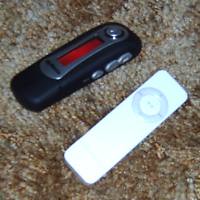 For various reasons, i have two mp3 players. I've had both units for more than a year. In fact, both units are no longer sold as new. Even though they both have excellent sound, I really only use one of them. Try to guess which one it is after the descriptions below.
One is the original Apple iPod Shuffle. It looks like a white pack of gum with a rounded rectangle look. It has a button in a ring. The button is the play/stop button. The ring has forward a track and (hold it down) fast forward, back a track and (hold it down) rewind, volume up and volume down. There's a blinking light indicating it's on, etc. I mostly ignore it. On the back, it has a three position switch which gives you power off, sequential play and shuffle mode. There's a button which lets you check the state of the internal battery. The light shows green, amber or red.
The unit has a USB connection. You mount it on some computer, add tracks, and delete tracks. You need software which knows how to update the database on the device, otherwise, the device won't play it. I use gnupod, since other software for the iPod doesn't really work for Linux. This software works on the command line, has awful syntax, but this can be fixed with aliases and such in your shell's startup file. The key is that it works. I could say that again, but you'd get bored. You can store things on it that aren't music, for example to copy things from one place to another. Inside, there is half a GB of flash. That's enough for 12 to 20 hours of content, depending on encoding, quality, etc. While you're connected, the battery charges. I don't think about the battery unless i'm going on a long trip. It usually works. But for long trips, the limit is 18 hours of use on a full charge. I haven't tested this lately.
If you pause the unit, it will eventually turn itself off. When you turn it on, it sometimes remembers where you were in a track, and sometimes it skips to the beginning of the track. Sometimes it forgets the track, and skips to the "first track". This is the same as the first track your computer reports is on the device. Sometimes, the software records that you deleted a track, but the track isn't actually deleted. It takes up space, but isn't accessible. It can be hard to figure out which track it is, or even notice that it has happened. The tracks are always renamed with a "1_" prefix added. Sometimes, part of the file names are removed. It might have something to do with the DOS FAT 32 filesystem, and name length limitations or name mangling. Hey, blame it on Micros~1.
The other unit was on sale at Radio Shack, and is called My Musix. It is black, rounded everywhere, slightly fatter than the Shuffle, but otherwise comparable in size. On the front is a fairly large dot matrix display, which tells you what you're doing. There is a big play/stop button. There is a forward track and reverse track rocker, and if you hold them, you get fast forward/reverse. There is a volume up and volume down rocker. There is a record button. There is device lock slider switch. Lock it, and other controls will not respond. Handy for preventing error.
Turn the unit on by pressing the Play button. Turn it off by pressing (and holding) the Play button. Play by pressing Play, right? Well, that depends on what mode you're in. Mostly, i press the Record button first, which puts it into a mode menu. Modes let you change folders, each which might have different content, like a book in one, and space music in another, and podcasts in a third. Have as many as you like. Another is Play mode, where you can opt for sequential or random play. Another mode is Delete. You can delete tracks from the interface. Another mode is Repeat - including none, one track, one folder. Another mode is FM Radio. You can tune in FM stations. You can even record FM. Play the FM later, or download it to your main computer. Another mode is Record. You can record ambient audio. The sound is recorded with 8 bit samples at 8 KHz. Not very high quality. There are two levels of menu. The settings menu has a mode for setting the screen backlight. You can use a red backlight - which is good for astronomy, as it doesn't ruin your night vision.
The unit has a USB connection. You mount it on some computer, add tracks, and delete tracks. No special software. When the device turns on, it figures out what it has, and lets you play it. You can store things on it that aren't music, for example to copy things from one place to another. It ignores things it doesn't understand. Inside, there is one GB of flash. That's enough for 24 to 60 hours of content. That's enough that you can stuff content in a folder for reference. It uses a AAA battery. I use rechargeable batteries. It gets about 8 hours on a charge, but you can bring more batteries with you, so you get infinite duration with minimal preplanning. If you don't preplan, there's always 7/11. And if your rechargeable battery dies a final death, you can always pick up more at the grocery store. The design of the battery cover door suggests that you'll misplace it sometime. So far, i've been careful, and though i've lost it twice, i've also quickly found it again. It's a nuisance when you have to pull off the road to fish under the seat. Probably should have pulled over to change the battery. Think safety first.
If you pause the unit, it will eventually turn itself off. When you turn it on, it sometimes remembers where you were in a track, but always skips to the beginning of the track. Sometimes it forgets the track, folder and everything. You usually get to the first track in a random folder. Well, it's random to me. It even forgets the track when you actually turn it off gracefully, sometimes. It sometimes suffers from the Micros~1 problem. However, it doesn't, in general, rename files. Though long folder names sometimes get renamed to eight characters. This summer, i loaded Lord of the Rings audio book tracks on it, and the unit was bricked. I called customer support, and got software that let me reflash it. The new software fixed the unusual characters in the filenames can brick the unit problem, and cleaned up some display bugs too. I now have the software, and can use it any time to unbrick the unit. Since the unit behaves so much better, i'm actually glad i had to reflash it. In fact, if they had a registration system, and could, for example, send you email when new operating software was available, it would be worth signing up for spam. In any case, the customer support rocked. It's hard to remember when i've dealt with good customer support before.
Note that both units have their faults. The Apple Shuffle needed to keep the form factor, fix rewind so that it can hack into the end of the previous track, fix it so that it remembers where it is in a track when it is turned off, and remove the "off" position, letting it toggle between sequential and shuffle mode only. The form factor is fine - it didn't need to be made smaller. I'd offer it in multiple colors, not just white. Of course, then i'd buy the unpopular polka dot version at discount.
The My Musix needs to have a single menu, not two nested menus. It needs to remember where it was when turned off. If it's going to record, it needs to be high quality 16 bit sound with at least 22 KHz samples, preferably CD rate samples. Mono is OK. The battery cover design needs fixing. The display shows the current track. But if the track title doesn't fit in the display, it scrolls. It starts scrolling instantly, which doesn't give you time to consume the first few characters. Just a couple second pause before scrolling would fix this. It should be offered in multiple colors, not just black. Of course, then i'd buy the unpopular polka dot version at discount.
OK, so which one do i use? Simple interface, half storage? Or complicated interface, replaceable batteries? The answer is that i nearly never use the My Musix. But one day the battery in the Shuffle will die, and i'll switch to the My Musix, and use it for twenty years. And i'll likely pine for the good old days when life was simple.
Friday, November 02, 2007
speling
I've used a spell checker ever since they became available. For me that was about 1980, on a DecSystem 20. That's when i first got access to a spell checker that could quickly offer good guesses as to what i probably intended. These spell checkers improved my spelling skill dramatically. At first, my essays were filled with errors. But, the spell checker would catch them, and usually offer the right word. I'd study how the word was really supposed to be spelled, and after being corrected twenty or thirty times, i'd start getting it right the first time. Spell checkers improved my typing as well.
One must still proofread. That's because spell checkers will not save you form every mistake.
One must still proofread. That's because spell checkers will not save you form every mistake.
Monday, October 29, 2007
Nokia 770 backup
The ssh package for the Nokia comes with sftp for file transfer. I thought to do backups by creating a big tar file and using sftp over WiFi to get a copy to my desktop. This is not an ideal solution, as one needs to create the whole archive before starting a transfer. That means you have to have enough space to create the archive. Now, the archive could take less than half of your space because tar doesn't waste any space in the last blocks of files, and the entire archive could be compressed.
But the ssh package also comes with scp. The -r option recurses directory trees, and the -p option preserves file modes. The -q option eliminates the messages about what file it's working on, and how far it has gotten, and how long it thinks it will take to finish. I've no idea how long it really takes. Just plug it into AC, connect to the backup machine via WiFi, start the scp, and call it a night.
On the backup machine, running linux, i use my mcmp program to detect files that are, in fact, identical to other files brought over from, for example, previous backups. It can create hard links from one to another, so the backup files only take filesystem space for files that actually changed. For me, that's not alot. Mostly what i do is copy books and audio to it. Reading these things does not cause the files to change. I really should release mcmp. It's fast and reliable.
The desktop computer is also backed up. I plug an external USB hard disk in, and tell it to make a copy. When it's done, i dismount the backup drive and power it down. That way a power spike can't take out both the primary and backup. Single files can be restored, if needed.
Do you have a backup plan for your computer(s)?
But the ssh package also comes with scp. The -r option recurses directory trees, and the -p option preserves file modes. The -q option eliminates the messages about what file it's working on, and how far it has gotten, and how long it thinks it will take to finish. I've no idea how long it really takes. Just plug it into AC, connect to the backup machine via WiFi, start the scp, and call it a night.
On the backup machine, running linux, i use my mcmp program to detect files that are, in fact, identical to other files brought over from, for example, previous backups. It can create hard links from one to another, so the backup files only take filesystem space for files that actually changed. For me, that's not alot. Mostly what i do is copy books and audio to it. Reading these things does not cause the files to change. I really should release mcmp. It's fast and reliable.
The desktop computer is also backed up. I plug an external USB hard disk in, and tell it to make a copy. When it's done, i dismount the backup drive and power it down. That way a power spike can't take out both the primary and backup. Single files can be restored, if needed.
Do you have a backup plan for your computer(s)?
Wednesday, October 10, 2007
Word as reader
Have i mentioned how terrible MS Word is as a document reader? Today? A couple starting caveats. First, i'm using Microsoft Word 2002 sp3. Second, this isn't just Microsoft bashing, as fun as that is. Many modern word processors suck as document reader applications. And yet, if someone writes a document in a proprietary format like Word, you expect that somewhere down the line, someone will use Word to read the document. It might be the author, for proof reading. It might be the prospective employer, who needs to read your resume (or is it CV now - latin seems to be making a comeback. Is that because of Harry Potter?).
So, what is it, exactly that is so awful? Is it Page Mode vs. Normal? Is it the zoom level, and having to zoom in when dealing with print resolution graphics, but then zooming out to cope with the text? Is it dealing with objects that don't fit on the screen?
No. It's the idea that the page down and page up buttons change your insertion point and any screen movement is incidental. So if you use the scroll bar, and then forget and use page down, it typically jumps back up.
I'd rant some more, it's so much fun, but there's little more to say.
So, what is it, exactly that is so awful? Is it Page Mode vs. Normal? Is it the zoom level, and having to zoom in when dealing with print resolution graphics, but then zooming out to cope with the text? Is it dealing with objects that don't fit on the screen?
No. It's the idea that the page down and page up buttons change your insertion point and any screen movement is incidental. So if you use the scroll bar, and then forget and use page down, it typically jumps back up.
I'd rant some more, it's so much fun, but there's little more to say.
Tuesday, October 09, 2007
Best Practices
A colleague had this collection of PDF documents on various aspects of building software. One, entitled High-level Best Practices in Software Configuration Management talks about how to get the most out of your source control system. It was written at Perforce Software, Inc., and though it tries to be general in nature, it reflects their product, which i've never used. It was written in 1998, and was obsolete at that time.
The paper talks about branching and code freezes and codelines and workspaces and builds and the processes that an organization must have to do to cope with a serious problem. Merges.
So, in the old days, one used a source control system, like SCCS or RCS, and of course others. In these systems, the source code cycle steps through these points:
This works OK, as long as you have only one developer, and one workstation for that developer. But the moment this isn't true, then at some point in development, one developer will have a file locked that another developer wants to edit. So, either the second developer waits for the lock to free - perhaps by doing something else, or the second developer asks the first to add her changes too, and check them in. Or perhaps even more creative solutions are explored.
But often, the second developer is working on a version of the code that will be released at some other time than the first developer is working on. Same application, just code that won't be released for an extra month. Then, each developer needs their own set. The usual way to do this is for at least one developer to create a branch, and work there. Now, when the first developer finishes his release, the code is checked in.
The second developer has a new problem. The code she started with isn't the code that's now in production. Changes made for the first release aren't in the code set for the second release. These changes need to be merged into the new set. The key point in this Best Practices paper is Get the right person to do the merge. It's important to do this step right because it is error prone, tedious, and did i mention error prone? I've done this work. I've even been the right person for the job. I volunteered for this work because I wanted it to be done right. It wasn't that my efforts would be lost if it wasn't done right. It was that the team's progress could be lost if it wasn't done right. And no one else on the team seemed to understand the problem. And yet, the correct right person to do the merge isn't a person.
As early as 1993, i was using CVS. Here, the computer performs the merges. It's fast and reliable. If the merge detects a conflict, it notates this in the code and allows the developer to fix it. But because of this simple change, the whole source code control flow changes. Now it's like this:
Now, the only time that the source code is locked is for a few seconds while the code is being checked back in. Since the code is nearly never locked, any developer can edit whatever they want whenever they want to. The merge happens during the update.
A merge conflict happens when there is a change to the same line of code. When that happens, the two versions of the code are marked in the updated file. The developer edits the file, figures out if one version, the other, or some new code is needed to resolve the conflict.
One might think that since updates are performed all the time, that developers would be constantly fixing merge conflicts. This is not the case. Generally, if two developers change the same line of code, it usually means that they are working on the same problem. If they aren't working on the same problem, there are seldom any conflicts.
So, in a multiple release system, branching is still needed. But the merging process can be automated. And it's long past time that we should need to do this by hand.
So, this is old news, right? Why rehash it now? Because vendors still sell obsolete software. For example, i work for a company now that uses Serena's Dimensions product. This product, based on PVCS, is an old style edit-with-lock and manual-merge system. It has some nifty work flow stuff layered on top, but the hard problems are still hard, and color the way any work is done. To wit, our current release is projected to be at least two weeks late because it was noticed too late that a merge would have to be made. (Sorry, Serena's site seems to be dehanced for Firefox with a pointless entry gate screen. Entry gates went out in about 1995.).
To be fair, i have no idea how Serena thinks that an issue like: Development processes involve time-consuming and unreliable manual hand-offs can be solved with their product. As near as i can tell, if you want overlapping releases, you are stuck with manual merge.
So who bought into this system? Why aren't we using CVS or SVN, which are free? Did they consult with senior developers? I wasn't consulted. These are Best Practices. It must be some definition of Best that i've not heard.
The paper talks about branching and code freezes and codelines and workspaces and builds and the processes that an organization must have to do to cope with a serious problem. Merges.
So, in the old days, one used a source control system, like SCCS or RCS, and of course others. In these systems, the source code cycle steps through these points:
- check out the code with an exclusive edit lock
- edit the code, and test it
- check the code back in.
This works OK, as long as you have only one developer, and one workstation for that developer. But the moment this isn't true, then at some point in development, one developer will have a file locked that another developer wants to edit. So, either the second developer waits for the lock to free - perhaps by doing something else, or the second developer asks the first to add her changes too, and check them in. Or perhaps even more creative solutions are explored.
But often, the second developer is working on a version of the code that will be released at some other time than the first developer is working on. Same application, just code that won't be released for an extra month. Then, each developer needs their own set. The usual way to do this is for at least one developer to create a branch, and work there. Now, when the first developer finishes his release, the code is checked in.
The second developer has a new problem. The code she started with isn't the code that's now in production. Changes made for the first release aren't in the code set for the second release. These changes need to be merged into the new set. The key point in this Best Practices paper is Get the right person to do the merge. It's important to do this step right because it is error prone, tedious, and did i mention error prone? I've done this work. I've even been the right person for the job. I volunteered for this work because I wanted it to be done right. It wasn't that my efforts would be lost if it wasn't done right. It was that the team's progress could be lost if it wasn't done right. And no one else on the team seemed to understand the problem. And yet, the correct right person to do the merge isn't a person.
As early as 1993, i was using CVS. Here, the computer performs the merges. It's fast and reliable. If the merge detects a conflict, it notates this in the code and allows the developer to fix it. But because of this simple change, the whole source code control flow changes. Now it's like this:
- check out the code
- edit the code, and test it
- update the local copy with changes from the repository
- check the code back in (but leave this new copy out).
Now, the only time that the source code is locked is for a few seconds while the code is being checked back in. Since the code is nearly never locked, any developer can edit whatever they want whenever they want to. The merge happens during the update.
A merge conflict happens when there is a change to the same line of code. When that happens, the two versions of the code are marked in the updated file. The developer edits the file, figures out if one version, the other, or some new code is needed to resolve the conflict.
One might think that since updates are performed all the time, that developers would be constantly fixing merge conflicts. This is not the case. Generally, if two developers change the same line of code, it usually means that they are working on the same problem. If they aren't working on the same problem, there are seldom any conflicts.
So, in a multiple release system, branching is still needed. But the merging process can be automated. And it's long past time that we should need to do this by hand.
So, this is old news, right? Why rehash it now? Because vendors still sell obsolete software. For example, i work for a company now that uses Serena's Dimensions product. This product, based on PVCS, is an old style edit-with-lock and manual-merge system. It has some nifty work flow stuff layered on top, but the hard problems are still hard, and color the way any work is done. To wit, our current release is projected to be at least two weeks late because it was noticed too late that a merge would have to be made. (Sorry, Serena's site seems to be dehanced for Firefox with a pointless entry gate screen. Entry gates went out in about 1995.).
To be fair, i have no idea how Serena thinks that an issue like: Development processes involve time-consuming and unreliable manual hand-offs can be solved with their product. As near as i can tell, if you want overlapping releases, you are stuck with manual merge.
So who bought into this system? Why aren't we using CVS or SVN, which are free? Did they consult with senior developers? I wasn't consulted. These are Best Practices. It must be some definition of Best that i've not heard.
Thursday, October 04, 2007
Alcohol
Very funny xkcd.com cartoon.
Since alcohol slows reflexes, one would think that it would slow thinking in general. As programming requires some of most intense thinking anywhere, one would expect that imbibing would categorically be a bad thing. Yet, there are two pieces of evidence that i'm aware of that contradict this.
I worked with a guy who preferred working from home, over a slow modem, to working in the office. At home, he could work with a six pack of beer (brand not specified). He said it was less painful. Let's say he sees a bug. When sober, his reaction was Damn! Another bug. But after a beer or so, his was reaction was Ha ha ha, another bug, and he'd get right to it. So, apparently, psychology can be an important factor for programming.
But i also did an experiment, mostly by accident. In the mid 80's, i was at this keg party of mostly geeks. Thing about keg parties is that i'm a really cheap drunk. It just doesn't take much to get a buzz. So, i can't really count cups (they were plastic, and so can't be properly called glasses) after one. I've no idea how much i had. Enough so the Universe spun, but not enough to bring me to the ground. Anyway, this guy, whose name i don't recall, was talking to me, and i mentioned this graphing package that i'd just written. We had forty something devices capable of plotting results, and they were all different. Our plotting packages only knew about three or four of these each, so you got your output on one of those. If you wanted output on a better one, you'd start from scratch using another package. So, i invented an intermediate format, and a series of filters that could translate to and from it. This guy said he had access to a new laser printer, and had the manual for it. How long would it take to create a filter? I'd have said a couple hours. You know, just take a filter that looks like it, and modify it. He wanted to do it right away.
Now my judgement was nearly entirely impaired, so despite the time, maybe two in the morning, we started right away. We staggered to my office, and started hacking at it. I don't remember the details. But when i got in to work later in the morning, the resulting filter still worked. Further, the code wasn't bad. Over time, the bugs will eventually show themselves. But no maintenance was needed for this filter. Ever.
Windows ME really was pretty awful. But it seems more likely that alcohol was involved in the decision to release it rather than in development.
Since alcohol slows reflexes, one would think that it would slow thinking in general. As programming requires some of most intense thinking anywhere, one would expect that imbibing would categorically be a bad thing. Yet, there are two pieces of evidence that i'm aware of that contradict this.
I worked with a guy who preferred working from home, over a slow modem, to working in the office. At home, he could work with a six pack of beer (brand not specified). He said it was less painful. Let's say he sees a bug. When sober, his reaction was Damn! Another bug. But after a beer or so, his was reaction was Ha ha ha, another bug, and he'd get right to it. So, apparently, psychology can be an important factor for programming.
But i also did an experiment, mostly by accident. In the mid 80's, i was at this keg party of mostly geeks. Thing about keg parties is that i'm a really cheap drunk. It just doesn't take much to get a buzz. So, i can't really count cups (they were plastic, and so can't be properly called glasses) after one. I've no idea how much i had. Enough so the Universe spun, but not enough to bring me to the ground. Anyway, this guy, whose name i don't recall, was talking to me, and i mentioned this graphing package that i'd just written. We had forty something devices capable of plotting results, and they were all different. Our plotting packages only knew about three or four of these each, so you got your output on one of those. If you wanted output on a better one, you'd start from scratch using another package. So, i invented an intermediate format, and a series of filters that could translate to and from it. This guy said he had access to a new laser printer, and had the manual for it. How long would it take to create a filter? I'd have said a couple hours. You know, just take a filter that looks like it, and modify it. He wanted to do it right away.
Now my judgement was nearly entirely impaired, so despite the time, maybe two in the morning, we started right away. We staggered to my office, and started hacking at it. I don't remember the details. But when i got in to work later in the morning, the resulting filter still worked. Further, the code wasn't bad. Over time, the bugs will eventually show themselves. But no maintenance was needed for this filter. Ever.
Windows ME really was pretty awful. But it seems more likely that alcohol was involved in the decision to release it rather than in development.
Friday, September 28, 2007
Psion Organiser II
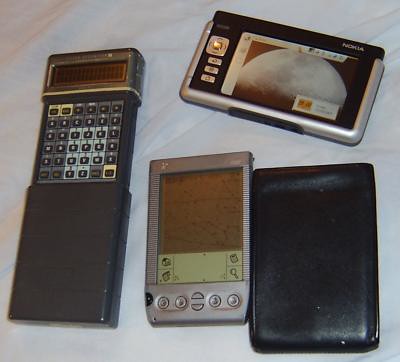 In 1987, i picked up two Psion II Organisers. They were really hot when they came out! They look pretty much the same as each other, but one has 32 KB RAM, and the other has 8 KB RAM. RAM is used for file storage too, but internal RAM has some special features. There are two slots for expansion memory for file storage. They come in two flavors. RAM with a watch battery for persistence. And EEPROM. The Psion can write to it. But you can't rewrite. This can be overcome by marking records for deletion. When it becomes full, copy the stuff somewhere else, erase the pack, then copy stuff back to it. This is how you get the space back from deleted files. They also came with an RS-232 serial cable, and you can copy files to a host, like DOS, back and forth. This is how backups are done. The 8 KB system has some limitations. It can't use my 32 KB RAM pack. You must have 4 KB RAM free to use the serial port. They also can make beeping sounds. Pitch and duration are controllable, so i wrote a music program. Sounds like one of those birthday cards that you open and it makes noise. But, you can write your own tunes, with multiple octaves, repeats, etc. The display is two lines of 16 characters. There are user defined characters, giving one almost pixel by pixel control.
The serial port on my 32 KB Psion died. That meant it could no longer be backed up, and i stopped using it for anything more than a calculator. The 8 KB Psion is still nearly pristine. Well, except that dates past 1999 don't work in the calendar. Feh. Bloody Y2K.
These machines have the Hitachi 6303x processor. This chip can access 64 KB of memory. Half of this is ROM, more or less. They run at about 2 MHz. The 9 volt battery lasts a couple months of normal use.
The applications include a calculator, calendar (appointments), notes, file transfer (with special software on the other side) and remote login (can act like a terminal). The units are also programmable. On board, there is a language called OPL. OPL is something like BASIC, but without line numbers, and with block structure. Even after years of not seeing this language, i can read and write these programs without reference to the manuals. There's something to be said for a language that easy. There is also a cross assembler that runs under DOS. I studied the manuals, but never actually wrote anything for it.
So, a comment suggested that my new Nokia 770 is probably much faster. No need to guess. I have benchmark results for both, using benchmarks i started using in 1982. Here are some numbers:
Matrix Multiply
| Time | x780 | Machine & Language |
|---|---|---|
| 0.0308 | 3143.2100 | Athlon 1913 MHz C |
| 12.1200 | 7.9900 | Athlon 1913 MHz Perl 5.8.8 |
| 5.1596 | 18.7800 | Nokia 770 C |
| 238.4700 | 0.4060 | Nokia 770 Perl |
| 9.8200 | 14.1300 | Compaq Aero 486sx/25 C |
| 25920.0000 | 0.0037 | PocketC Visor Platinum |
| 612000.0000 | 0.0001 | Psion Organiser IIXP OPL |
Sieve
| Time | x780 | Machine & Language |
|---|---|---|
| 0.060 | 2310.2300 | Athlon 1913 MHz C |
| 19.570 | 7.0900 | Athlon 1913 MHz Perl |
| 0.896 | 154.7900 | Nokia 770 C |
| 181.750 | 0.3800 | Nokia 770 Perl 5.8 |
| 278.214 | 0.4490 | Compaq Aero 486sx/25 C |
| 90744.133 | 0.0014 | Compaq Aero 486sx/25 Perl* |
| 22135.000 | 0.0063 | Palm Platinum Cbasic |
| 57000.000 | 0.0020 | Psion Organiser II OPL |
Unfortunately, i don't have Perl benchmark runs for the Aero. I probably hadn't written them yet. I have extrapolated a Sieve Aero time using Athlon times. This doesn't work for the Matrix Multiply, as the 486sx/25 didn't have floating point hardware. But to be fair, i didn't use Perl on it much. No, i really don't have eight significant digits of timing information. I'm just trying to get the decimal points to line up. Benchmarks like this often have a ten percent variance between runs anyway. The Vax 780 was benchmarked in the early 1980's, and was considered by many to be the 1 MIPS (Million Instruction per Second) machine. But since some machines must execute more or fewer instructions to get something done, a more fair comparison is to test some workload.
There are two workloads here. The Matrix Multiply does lots of floating point multiplies and adds, with two dimensional array indexing. The Sieve performs integer comparisons and single dimensional array indexing. Since neither the Palm nor the Psion have floating point hardware, both of these machines perform relatively better at the Sieve than the Matrix Multiply. The Psion CPU doesn't have integer multiply, handy for two dimensional arrays.
But yes. The new Nokia is 300 times faster for the Sieve, and 2,500 times faster for the Matrix Multiply. And yet. Both of these benchmarks are in languages that compile to a virtual machine code, which is then interpreted. Any semi-modern desktop using a real compiler should be 20 million times faster than the Psion. When i get a benchmark run in C on the Nokia (easy enough), i expect a factor of 300 to 400 improvement over the Perl version. And if i manage to shoehorn the matrix multiply into the Nokia's DSP (Digital Signal Processor - a super computer's vector processor of sorts) (and more difficult to accomplish) then the sky's the limit. That's how the Nokia does sound and video, after all. Or, i might run into the short vector lengths (20). To be fair, i haven't attempted this in the Athlon's funky on-chip FPUs or GPU.
A brief note about Perl. Yes, there's a huge performance hit compared with C. But even on the 486sx/25, many applications would be fine. For example, many web based programs would still finish in much under a second, and you'd think it fast. And for some machines, it's not a factor of 300, it's a factor of 1,000. And it's still OK. This still bothers me. Perl 5.8 (and later, i suppose) comes with a Perl compiler, which improves things by a factor of five. I don't see it used much. Another odd thing is how little code i have hanging around written in Perl at home. For the past six years or so, it's been my primary language. But when i want to write something at home, it's nearly always in C.
Thursday, September 27, 2007
Nokia 770
The digitizer on my 2002 vintage Handspring Visor Palm Pilot is crapping out on me. It's functional, but every few seconds, i have to recalibrate the digitizer. Sometimes, it messes up during the recalibration, and it can take five minutes to get through it. It often helps to try twisting the whole device this way and that to get it to work. So, i want to replace it.
Some history. Before getting the Visor, i had a 3.5 pound subnotebook. It could do everything my desktop could do, but with less memory and disk. Further, it could communicate with my desktop fast enough for backups and data sharing. But, it was more expensive than my desktop. When it died, i did without for a number of years. Eventually, i picked up the Visor, and though i lost much of what i'd used the subnotebook for, i started using the Visor for new things that i now depend upon.
One way to replace the Visor is to pick up a cheap Palm. The cheapest $100 Palms have three or four times as much memory, are faster, and have color. What's not to like? Just backup the Visor, restore to a new device, and get on with life. But i'm the type of guy who shops carefully for bananas. This is much more important and expensive than bananas.
The deep dive investigation should take into account the Three P's. Portability, Performance, and Price. If it isn't portable, you won't use it. If it can't do what you want, you won't use it. If you can't afford it, don't buy it. But otherwise, price can be optimized. You might get performance at the sacrifice of portability. That would be the desktop.
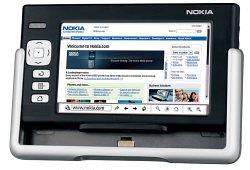 I did a wider search for bliss, and discovered that the Nokia 770 (in process of being replaced by the newer, bigger Nokia 800) has been heavily discounted, and appears in my price range. It has some new capability. It combines the functionality of my old subnotebook, but with the portability and applications of an organizer. It runs Linux, like my desktop, though that isn't evident from the casual look. Linux is under the hood, and i can get at it. It has the power and resources to do things even a new Palm won't do. Here's a comparison:
While the 770 has a stylus, it also has remote login, as did the subnotebook. But that means that one can use the desktop's keyboard. Further, a wireless bluetooth (or WiFi?) keyboard can be purchased. A USB keyboard might be usable, but the 770 does not have a powered USB port, so a powered hub would be needed. To make it portable, you'd need a battery powered powered USB hub. A bluetooth keyboard would be cheaper and easier. I'll try remote login from the desk first.
In the last months of my Visor, i experimented with various languages for it. Chipmunk Basic is free, but is a crippled version of BASIC, and is slow. Lispme is free, implements a variant of scheme, nearly produces executables that you can hand out (you need to give them the whole environment), the environment is fragile, and the speed isn't very good. There is a free C cross platform compiler that runs under Linux, but what i'm looking for is something i can goof around with on the device. Really, the Visor is too slow to be acceptable for an interpreter. Further, the Visor's one-app-at-a-time execution environment means that the user has to wait for any computation to take place. My best guess is that Quartus Forth is the best language. It's not free, but it produces small standalone executables. Too late.
By contrast, the Nokia 770 has a Perl environment installed when you buy it. That means i can hand out a perl script, and that's it. It will just work. And tiny perl scripts can do alot. There's also a shell, so shell scripts are also possible out of the box. While there is a native C compiler - word on the street says it runs out of resources for non-trivial applications. There is a cross platform C compiler. Python and Ruby can be installed. Further, the processor performance is high enough that a language that does not compile to the native iron, like Perl, Ruby and Python, is acceptable for a large number of applications. Further, since it really multitasks, the user can start a computation, and do something else while waiting.
It's been about a week. So, for example, i haven't tracked down and installed a calendar application. So far, the search has only turned up an app that can't turn on the machine and beep. On the other hand, i haven't even gotten a wireless router set up. How have i gotten anything? Well, one of my neighbors, has an open wireless setup, and cable. Thanks, whoever you are. I've been real happy with it so far. But the real test is how i'll like it over the next few weeks.
The latest news is that it appears that there is a Palm OS emulation application. It may be possible to download my favorite Palm OS apps, and run them on the Nokia.
Some history. Before getting the Visor, i had a 3.5 pound subnotebook. It could do everything my desktop could do, but with less memory and disk. Further, it could communicate with my desktop fast enough for backups and data sharing. But, it was more expensive than my desktop. When it died, i did without for a number of years. Eventually, i picked up the Visor, and though i lost much of what i'd used the subnotebook for, i started using the Visor for new things that i now depend upon.
One way to replace the Visor is to pick up a cheap Palm. The cheapest $100 Palms have three or four times as much memory, are faster, and have color. What's not to like? Just backup the Visor, restore to a new device, and get on with life. But i'm the type of guy who shops carefully for bananas. This is much more important and expensive than bananas.
The deep dive investigation should take into account the Three P's. Portability, Performance, and Price. If it isn't portable, you won't use it. If it can't do what you want, you won't use it. If you can't afford it, don't buy it. But otherwise, price can be optimized. You might get performance at the sacrifice of portability. That would be the desktop.
I did a wider search for bliss, and discovered that the Nokia 770 (in process of being replaced by the newer, bigger Nokia 800) has been heavily discounted, and appears in my price range. It has some new capability. It combines the functionality of my old subnotebook, but with the portability and applications of an organizer. It runs Linux, like my desktop, though that isn't evident from the casual look. Linux is under the hood, and i can get at it. It has the power and resources to do things even a new Palm won't do. Here's a comparison:| Feature | Compaq Aero | Visor | Nokia 770 |
|---|---|---|---|
| Date | 1995-1999 | 2002-2007 | 2007+ |
| Display | 640x480 grey | 160x160 b/w | 800x480 color |
| Data entry | keyboard, mouse | stylus | stylus * |
| Carry in | brief case | ||
| Performance | 10 MIPS | 5 MIPS | 100 MIPS |
| Communications | Cable 22 KB/sec | USB 100 KB/sec | USB or Wireless 1 MB/sec |
| Programmable | Yes | Not really | Yes |
| Apps used | note pad, planetarium, book reader, calculator, Web GUI-DB backed app development, web browsing | note pad, planetarium, book reader, calculator, calendar, sketch, contacts, music apps. | Video clips, photo album,note pad, planetarium, book reader, PDF reader, calculator, calendar, sketch, contacts, music apps, Web GUI-DB backed app development, web browsing |
| User file store | 70 MB | 4 MB | 192+ MB |
| Cost | $600 | $110 | $150 (sale) |
While the 770 has a stylus, it also has remote login, as did the subnotebook. But that means that one can use the desktop's keyboard. Further, a wireless bluetooth (or WiFi?) keyboard can be purchased. A USB keyboard might be usable, but the 770 does not have a powered USB port, so a powered hub would be needed. To make it portable, you'd need a battery powered powered USB hub. A bluetooth keyboard would be cheaper and easier. I'll try remote login from the desk first.
In the last months of my Visor, i experimented with various languages for it. Chipmunk Basic is free, but is a crippled version of BASIC, and is slow. Lispme is free, implements a variant of scheme, nearly produces executables that you can hand out (you need to give them the whole environment), the environment is fragile, and the speed isn't very good. There is a free C cross platform compiler that runs under Linux, but what i'm looking for is something i can goof around with on the device. Really, the Visor is too slow to be acceptable for an interpreter. Further, the Visor's one-app-at-a-time execution environment means that the user has to wait for any computation to take place. My best guess is that Quartus Forth is the best language. It's not free, but it produces small standalone executables. Too late.
By contrast, the Nokia 770 has a Perl environment installed when you buy it. That means i can hand out a perl script, and that's it. It will just work. And tiny perl scripts can do alot. There's also a shell, so shell scripts are also possible out of the box. While there is a native C compiler - word on the street says it runs out of resources for non-trivial applications. There is a cross platform C compiler. Python and Ruby can be installed. Further, the processor performance is high enough that a language that does not compile to the native iron, like Perl, Ruby and Python, is acceptable for a large number of applications. Further, since it really multitasks, the user can start a computation, and do something else while waiting.
It's been about a week. So, for example, i haven't tracked down and installed a calendar application. So far, the search has only turned up an app that can't turn on the machine and beep. On the other hand, i haven't even gotten a wireless router set up. How have i gotten anything? Well, one of my neighbors, has an open wireless setup, and cable. Thanks, whoever you are. I've been real happy with it so far. But the real test is how i'll like it over the next few weeks.
The latest news is that it appears that there is a Palm OS emulation application. It may be possible to download my favorite Palm OS apps, and run them on the Nokia.
Tuesday, September 25, 2007
My job is so secret
So, imagine that you have a development cycle where a two line can take six months to make it into production, assuming diligent developers and savy management. By the time the fix gets into place, everyone involved has forgotten what needed fixing. Devlopers have been working in a devlopment environment, where the fix has been around for ages. Testers have to be reminded that it isn't a new bug, and, by the way, the fix is in the pipeline. End users have forgotten that they needed it fixed.
My job is so secret that not even i know what i'm doing.
My job is so secret that not even i know what i'm doing.
Wednesday, September 19, 2007
 It was
 Thursday, September 13, 2007
Dark Energy
I was at the store the other day, and noticed that they now sell disk drives that can hold a terabyte of data. Well, of course they hold more data. The whole Universe is expanding!
Tuesday, September 11, 2007
Queues
The third Rule of Acquisition clearly states, "Never pay more for an Acquisition than you have to", ST:DS9, The Maquis, Part II.
So, large American, Car companies want to save money while conducting their business. Business is complex, and computers can help keep track of things, etc., so they use them. Over time, the Information Technology department becomes rather large and complicated in and of itself, so they look for ways to save money there, too. All this is natural.
One of the issues with computers is that they themselves are rather complex, and require considerable training to use, program and maintain. Good database administrators, programmers, systems administrators, etc., are highly skilled people and therefore are expensive. In general, companies are drawn to organize these people by skill, putting like people into like groups. For example, there's a systems administration group, or a database administration group. A programmer, attempting to write or maintain some application needs to communicate with such a group to make use of such expertise, but also to get access to relevant systems to make needed changes.
As the organization grows, these groups change from technology enablers, to technology gate keepers. They become responsible for systems security, enforcing corporate policies, and so on. To reduce costs, these groups are reduced in size until each person is fully loaded with work. The result is that when a programmer needs to make changes in a system, their request enters a queue, and weeks go by before any action is taken. When mistakes are made, more weeks go by before corrective action is taken. This can be true even for the most trivial of changes, where the programmer had appropriate expertise to make changes, but did not have authority.
And, an honest analysis shows that the body count isn't reduced. It turns out that both the requesting programmers, and the servicing administrators are required to fill out paperwork, perform extra unneeded steps, and real productivity is minimal. The customer has to wait longer, and everyone ends up with more overhead than actual productive work. Far from ensuring quality, mediocrity is enforced. This is not the fault of the individuals.
This tendency to crowd people together by type has long been recognized in industry. The resulting stovepipes generate communications difficulties and pointless overhead. It is not unusual for the overhead to exceed an average of twenty or thirty times the amount of real work, as measured in hours. Worse, much of the overhead is geared to measure progress. Data from these logs are used by managers to show that the system is becoming more efficient, even as latencies grow ever longer. These statistics are, of course, wrong, not just misleading.
Clearly, it's no fun to work in an environment that is mired in bureaucracy. But how does one fix the system? The key is to point out just how terrible the system has become for the end customer. Further, one needs to point out how the head count has grown while productivity has decreased. The evidence clearly shows that small integrated teams, with all the expertise in a tighter nit group are considerably more effective. One needs systems administration, database administration, developers, business liaisons all in one place. If single individuals have competence in more than one area, they are that much more effective. That suggests that small groups control their hardware, systems software, and applications software. Small groups should develop their own standards for backup, source control, coding style and database naming conventions, application deployment, and so on.
Sure, the larger company should have policies, but the development group should be able to treat these as suggestions. If they decide to deviate from company policy, they should be able to do so without a waiver of any kind. Then, the policies will reflect business needs, rather than reflect blind guesses.
What about external requirements, like SOX? These are business requirements, like any other. Let the development group handle them. If they require reporting, then reports become policy or part of the automation, as makes sense. The key is that things should make sense.
So, large American, Car companies want to save money while conducting their business. Business is complex, and computers can help keep track of things, etc., so they use them. Over time, the Information Technology department becomes rather large and complicated in and of itself, so they look for ways to save money there, too. All this is natural.
One of the issues with computers is that they themselves are rather complex, and require considerable training to use, program and maintain. Good database administrators, programmers, systems administrators, etc., are highly skilled people and therefore are expensive. In general, companies are drawn to organize these people by skill, putting like people into like groups. For example, there's a systems administration group, or a database administration group. A programmer, attempting to write or maintain some application needs to communicate with such a group to make use of such expertise, but also to get access to relevant systems to make needed changes.
As the organization grows, these groups change from technology enablers, to technology gate keepers. They become responsible for systems security, enforcing corporate policies, and so on. To reduce costs, these groups are reduced in size until each person is fully loaded with work. The result is that when a programmer needs to make changes in a system, their request enters a queue, and weeks go by before any action is taken. When mistakes are made, more weeks go by before corrective action is taken. This can be true even for the most trivial of changes, where the programmer had appropriate expertise to make changes, but did not have authority.
And, an honest analysis shows that the body count isn't reduced. It turns out that both the requesting programmers, and the servicing administrators are required to fill out paperwork, perform extra unneeded steps, and real productivity is minimal. The customer has to wait longer, and everyone ends up with more overhead than actual productive work. Far from ensuring quality, mediocrity is enforced. This is not the fault of the individuals.
This tendency to crowd people together by type has long been recognized in industry. The resulting stovepipes generate communications difficulties and pointless overhead. It is not unusual for the overhead to exceed an average of twenty or thirty times the amount of real work, as measured in hours. Worse, much of the overhead is geared to measure progress. Data from these logs are used by managers to show that the system is becoming more efficient, even as latencies grow ever longer. These statistics are, of course, wrong, not just misleading.
Clearly, it's no fun to work in an environment that is mired in bureaucracy. But how does one fix the system? The key is to point out just how terrible the system has become for the end customer. Further, one needs to point out how the head count has grown while productivity has decreased. The evidence clearly shows that small integrated teams, with all the expertise in a tighter nit group are considerably more effective. One needs systems administration, database administration, developers, business liaisons all in one place. If single individuals have competence in more than one area, they are that much more effective. That suggests that small groups control their hardware, systems software, and applications software. Small groups should develop their own standards for backup, source control, coding style and database naming conventions, application deployment, and so on.
Sure, the larger company should have policies, but the development group should be able to treat these as suggestions. If they decide to deviate from company policy, they should be able to do so without a waiver of any kind. Then, the policies will reflect business needs, rather than reflect blind guesses.
What about external requirements, like SOX? These are business requirements, like any other. Let the development group handle them. If they require reporting, then reports become policy or part of the automation, as makes sense. The key is that things should make sense.
Wednesday, August 29, 2007
Thumb loading
I talked about thumb drives a while back. And, i'm at it again, downloading huge amounts of stuff and tossing it onto thumb drives.
Not only does it take awhile to fill a 2 GB kingston, but it also sends the load average through the roof. It's typical to take an otherwise unloaded system from a load of zero to a load of 5. And, it stays there for the duration. What's with that? The CPU is 99.7% idle. So, it's not like parallel ports where the CPU needs to do something every few bytes transfered. What are the other 4 tasks waiting to run? And despite the low CPU load, responsiveness during copies to the USB thumb devices is sluggish and jumpy.
This is under Linux.
Anyone have any idea why? Is it different under Windows? Mac? OS/X?
Not only does it take awhile to fill a 2 GB kingston, but it also sends the load average through the roof. It's typical to take an otherwise unloaded system from a load of zero to a load of 5. And, it stays there for the duration. What's with that? The CPU is 99.7% idle. So, it's not like parallel ports where the CPU needs to do something every few bytes transfered. What are the other 4 tasks waiting to run? And despite the low CPU load, responsiveness during copies to the USB thumb devices is sluggish and jumpy.
This is under Linux.
Anyone have any idea why? Is it different under Windows? Mac? OS/X?
Tuesday, August 28, 2007
Canoe trip

It's late in the season, but the canoe trip experience has finally taken place. We're not talking about a shakeout run to make sure everything works. We're also not talking about days on the water, or some other big deal. But, a trip with passengers. It's taken nearly a month to get it together.
Since we're, at heart, city folk, the trip takes place in a city. The Huron River runs through Ann Arbor, MI. Since it was otherwise quiet and peaceful, we brought along a couple ten year olds to provide continuous noise. The ducks were unable to compete with this noise, and so, stayed quiet themselves.
Gorgeous day. This is, unfortunately, the best picture taken all day. It had to be modified to look even this good. Mallards, i think.
Monday, August 27, 2007
Internal Discipline
 When we last left our hero the large organization was overrun by high latency task groups that were effectively obstacles to progress.
Another feature of large organizations, and by large i mean organizations with more than one person, is externally applied discipline. The problem to be solved is How does one motivate the employee to produce good work?. For the software developer, it's the wrong question.
One of the common management approaches to this problem is characterized by the carrot and stick paradigm. The idea was that to get a horse to pull the buggy, one had a carrot and a stick. The carrot was a reward for good behavior. The stick was punishment for bad behavior. Now, modern management has no experience with horses, or they'd know that the stick was not for punishment. The carrot was suspended by a string from the stick. But that isn't the modern interpretation.
Any parent will note that a promised reward is a much better motivator than punishment for children. In fact, punishment doesn't work very well, and not at all over the long haul.
But managers generally don't think that they have anything to offer an employee (which is false). They also don't think that they can get away with much in the way of punishment (which is also false). So, despite the above very common and widely talked about concept, it often plays almost no actual role in obtaining quality work.
What managers really know how to do is the paper trail. To get the developer to use source control, have a manager sign off that code is in the system. To get the developer to adhere to database standards, have a database administrator approve any database usage or changes. To get the developer to add user level help pages, have someone who only handles installing help pages on the system review the text and install it. To make sure that the customer is satisfied, have the customer sign off on the project before it is placed on the server. Each of these processes adds delays to the project, but do they ensure quality?
No. It turns out that the database administrator doesn't know anything about the application code. So even a simple query that uses only indexed keys might in fact be issued to the database millions of times. Only the developer would know that. The help text manager doesn't really know the application, and can easily miss omissions and outright errors in the text. Worse, help text usually concentrates on the details of how a function works, but never gives the end user any idea why one might want to use the function. That takes context. The customer signs off on the application, but does so at application launch. It may be a month before the customer is familiar enough with the product to be able to really evaluate it.
External discipline is inefficient and ineffective. The solution is to empower the developer to do the right thing. First, the developer should be aware of the kinds of quality that the customer wants. It may be consistency, repeatability, discoverability, ease of use, etc. Second, for those quality issues that only a developer could understand, review should be made by another developer. Code reviews have the side benefit of disseminating knowledge. Even the most senior developers learn something. Involve the database administrators early in the process, not late. The DBA should suggest good ways to do things up front, not stall a project nearing completion. To do that, the developer and the DBA need to work together. For best possible speed, they should be a single person. The customer should be able to give feedback at any time, not just before the launch.
Thursday, August 23, 2007
Empowerment
Large organizations have a problem. It's a hard problem to solve. That is, how do you organize the division of labor when you have a large number of people? It's not a new problem. Sun Tzu's The Art of War covers it. The general was asked, "How large an army can you command?". His answer was "the larger the better". Old problem but solved.People tend to learn new skills fairly slowly, so it is commonly thought that no one knows how to do everything. In any case, the large organization tends to discover, often by luck, that a person knows how to do some specific task, and then uses them for that one task exclusively. As the organization gets larger, groups of people form to perform specific tasks, and the organization tends to treat these the same as individuals, performing one task forever.
The large organization then takes these task groups and establishes processes that let the groups get things done together. When there is a complaint that the process isn't written down, it tends to get written, and becomes less flexible. When problems of quality arise, and let's face it, humans make mistakes, the reaction is to manage quality by requiring that a high level manager signs off on actions. But these people don't know how to do everything, so they don't know how to judge quality. They become a source of latency for projects, with no added value. Management thinks in terms of paper trails, and requires paper documents for everything.
The ebb and flow of work to do means that some task groups feel overloaded from time to time. They set up often elaborate queues where tasks are submitted, and 'customers' are given a minimum wait to get things done. For example, a database administration group may require a minimum of a week for any task - even if the task requires no analysis, no research, no diagnosis, just a simple command sent to the software. Often, these groups require that there is no face to face or even phone contact, and miscommunications are frequent, requiring resubmission of the task, with attendant latency.
So, let's say you're a developer, and the project is to project a web based application. Checking your source into the source tree requires sign off from the source code control group. Placing the application on the server requires sign off from the hardware and web server software groups. The database administrators need to sign off on the way the database is used, even if there are no new tables. The help text for your application is managed by yet another group. The application took a week to write, but takes an additional six weeks to deploy, if you're lucky.
How can this be fixed? Instead of attempting to manage quality by instituting sign offs by management enforced by restricted access to systems, the trend should be to manage quality by automated paper trails, with automated back-out systems for failure mitigation. The emphasis is on automation to reduce latency. Empower the developer to get things done by giving them the tools needed to get the entire job done. Trust that the developer will attempt to do the right thing, but don't be afraid of failure. Fear of failure causes paralysis.
There are a complicated set of issues. For brevity, this is just one of them.
Monday, August 20, 2007
Wednesday, August 15, 2007
Monday, August 06, 2007
Tom Swift
 On the way home from Bible Camp, my ten year old son and i listened to a 4 hour book downloaded from Librivox. Tom Swift and the Visitor From Planet X, written by Victor Appleton II. It went over well. There was a cliff hanger every chapter, except the last. This could be serialized on radio easily. 20 Chapters, so they must have only been ten or fifteen minutes each. That's short enough for nearly any attention span.
The reader, Mark Nelson is very good. No memorable mistakes. Maybe there aren't any. He does it with a 1950's style, with gusto, WoWee! But should you want to read it yourself, the full text is available on Gutenberg.
It's science fiction, with an action/adventure feel, but i had difficulty placing just when it might have been written. It has a 1950's style, but seemed to have references to more modern inventions. Fortunately, one doesn't have to guess, since Wikipedia knows it was written in 1961. And, it knows who Victor Appleton II is, and what a busy guy Tom really is. He had something like a hundred such adventures. And those are just the ones that have been written up so far.
The story has it all. Hot sex - well - there was a quick kiss on the cheek. I wasn't paying attention. It might have been Tom's sister. And, it has violence. Well, there was an earthquake, and some property damage. Space aliens, including the Visitor from Planet X. I was hoping the space alien would have something to teach us about global warming or world peace. Not a word. The one named villain turned out to be a spy working for the good guys. In retrospect, it's hard to believe there were 19 cliff hangers.
Monday, July 30, 2007
Canoe
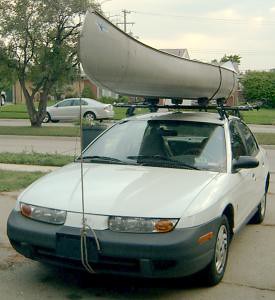 So, the canoe and bike rack was last set up on the previous car. It's a fairly fancy Yakima setup. There are these adapters, and the rack has been on four different cars now. But it had never been on the Saturn, so it was an hour getting it there. There probably is a clip designed for the Saturn, but i was able to make an existing set work. At least it's secure. Well, i didn't do the acid test - drive on the highway. I would have, but the on ramp to i75 south was closed. The primary test wasn't the drive, it was the canoe.
So, the canoe works. You see, there are paddles, and life jackets. A water bottle. Some binoculars. Can't go anywhere without binoculars. And... and that's it. So really, most of the test was getting the canoe onto a car.
With the rack on the car, the next step is to find the key, and unlock the lock which holds the chain. This is easy, since the lock was unlocked just a couple months ago. Except, that the key can't be found anywhere. After a half hour fruitless search, it is decided that one link of the chain can be cut, freeing the lock, and by the way, the canoe. This takes an hour. It's a very good chain (now slightly shorter).
I'd have never designed a canoe rack that has the canoe upright. I mean, when it rains, it fills with water, right? If too much water gets in there, then what do you do? The car could be overloaded, or the canoe might be too heavy to remove. Bail it? So far, though, it just hasn't been a problem. And for some reason, i've never thought to load up the canoe with everything in sight. One can put alot of stuff into a 17 foot canoe.
One nice thing about the rack is that in addition to the canoe, two bicycles can go up there. And, they go up without rubbing against anything. Nothing worse than a bike rack that damages the bikes. Or the car.
The test run for the canoe involves putting it into the water, and paddling around for a couple hours. Elizabeth Park has a nice parking lot, a little channel that goes out to the Detroit River. From there, one gets to deal with wind and waves. My trip took me to the bridge, which swung open to let a large boat through - always exciting.
And, i made it back alive. Mostly. Nothing damaged that can't be cured
with a little wine and a long bath in the hot tub.
Monday, July 23, 2007
Harry Potter Book 7 - no spoilers
I've now read half of the book. The non-spoiler review so far: i like it.
There's not much to say beyond that without giving something away.
So, I'll stop.
Please don't post your spoiler here.
For example, don't flip to the last page and tell me the last word.
Even if that word turns out to be "the" (which is unlikely. I'm not sure
i could construct a sentence that ends with the word "the").
I'm not reading the web until i've finished the book. It could be
a few days. Unfortunately, i have to eat and sleep, too.
There's not much to say beyond that without giving something away.
So, I'll stop.
Please don't post your spoiler here.
For example, don't flip to the last page and tell me the last word.
Even if that word turns out to be "the" (which is unlikely. I'm not sure
i could construct a sentence that ends with the word "the").
I'm not reading the web until i've finished the book. It could be
a few days. Unfortunately, i have to eat and sleep, too.
Monday, July 02, 2007
iPhone Diet
 The new buzz is that one of the women at work got a new iPhone over the weekend. She's been goofing with it, and showing it off, pretty much as one might expect. In fact, lunch got moved back quite a bit. Not just for her, but for many of us.
I'm calling it the iPhone Diet. It can affect those around you, too. And, they don't get to decide if they want to participate. I didn't get to decide, and i don't even want a phone. My angle is more what user interfaces could be adopted for the Palm Pilot.
This isn't a balanced diet. You could get serious malnutrition from it, if prolonged. Fortunately, like most diets, it isn't expected to last.
See also, the Relative Diet, and Zeno's Diet.
Wednesday, June 27, 2007
Bad Weather
 We have a thunderstorm, right now, raging outside. I'm glad i closed my windows.
If you closed your windows, how did you post to your blog?
I mean, the windows in my car.
Monday, June 18, 2007
Coolest new app
Well, it's new to me.
sudo apt-get install dict
sudo apt-get install dictd
sudo apt-get install dict-web1913
This gives you a 1913 English dictionary with definitions, from a local dictionary. That means it continues to work even if you are off line. From the command line, this example gives you a definition:
dict synopsis
sudo apt-get install dict
sudo apt-get install dictd
sudo apt-get install dict-web1913
This gives you a 1913 English dictionary with definitions, from a local dictionary. That means it continues to work even if you are off line. From the command line, this example gives you a definition:
dict synopsis
Friday, June 08, 2007
How fast is your thumb?
My beloved 128 MB Jump drive is lost. Stolen, actually. One of the things that i really liked about it was that the cap really sealed the stuff inside. It survived being left in a pocket and going through the wash. Twice.
My 512 MB Firefly was lost, so i had no thumb drive at all for several weeks. Well, not exactly. My iPod Shuffle is 512 MB (discontinued), and often has 100 MB free, and can be used to transfer arbitrary files too. But, I finally broke down and went to a store. My Jump drive cost something like $35 way back when, and being somewhat short on cash, i wasn't going to spend more than $20. I'd just have to get a small one. In a bin by checkout at MicroCenter, were 2 GB Kingston drives for $15.95. With tax, that's $16.90. So much for settling for a small one.
The Firefly turned up shortly thereafter. Both drives are in use. And something odd turned up. I downloaded interesting audio books from LibriVox, which turned out to be several gigabytes. The Kingston drive seemed to take quite a while to fill compared to the Firefly. Yet, transfer speed at home was much better.
At first, i thought that perhaps the computer at work had an older USB 1.0 interface. That's absurd, though. It's nearly three years younger than my computer at home. And, why would the FireFly be so much quicker? Well, the firefly is a quarter of the size, so maybe that's it. There's no way to get to the bottom of this without some measurements.
It turns out that i'm only writing data at work, and only reading it at home. And the Kingston is nearly nine times slower writing than reading. The Kingston is about 20% faster at reading than the Firefly. But the Firefly is only half as fast writing than reading. So, the Firefly is four times faster writing than the Kingston. And, since it's a quarter the size, filling it takes a 16th of the time.
OK, so the speed of the device is not listed anywhere. Would it be a deal breaker? No. It's quick enough, cheap, and has large tracks of land.
My 512 MB Firefly was lost, so i had no thumb drive at all for several weeks. Well, not exactly. My iPod Shuffle is 512 MB (discontinued), and often has 100 MB free, and can be used to transfer arbitrary files too. But, I finally broke down and went to a store. My Jump drive cost something like $35 way back when, and being somewhat short on cash, i wasn't going to spend more than $20. I'd just have to get a small one. In a bin by checkout at MicroCenter, were 2 GB Kingston drives for $15.95. With tax, that's $16.90. So much for settling for a small one.
The Firefly turned up shortly thereafter. Both drives are in use. And something odd turned up. I downloaded interesting audio books from LibriVox, which turned out to be several gigabytes. The Kingston drive seemed to take quite a while to fill compared to the Firefly. Yet, transfer speed at home was much better.
At first, i thought that perhaps the computer at work had an older USB 1.0 interface. That's absurd, though. It's nearly three years younger than my computer at home. And, why would the FireFly be so much quicker? Well, the firefly is a quarter of the size, so maybe that's it. There's no way to get to the bottom of this without some measurements.
It turns out that i'm only writing data at work, and only reading it at home. And the Kingston is nearly nine times slower writing than reading. The Kingston is about 20% faster at reading than the Firefly. But the Firefly is only half as fast writing than reading. So, the Firefly is four times faster writing than the Kingston. And, since it's a quarter the size, filling it takes a 16th of the time.
OK, so the speed of the device is not listed anywhere. Would it be a deal breaker? No. It's quick enough, cheap, and has large tracks of land.
Wednesday, May 30, 2007
Carded
They card you for Nyquil. Perhaps it still has alcohol.
I would not give anyone like this any strange ideas. For example, when crossing the border into Canada (or on the way back to the US), and they ask, Do you have any drugs?, it's probably not such a good idea to say, "Damn. I left them at home. I knew I forgot something!
When crossing the border, and they ask, Do you have any fire arms? It's probably not a good idea to reply, I can get you anything you want.
But let me know when you're going. I'd like to go along and see if they strip search you.
I would not give anyone like this any strange ideas. For example, when crossing the border into Canada (or on the way back to the US), and they ask, Do you have any drugs?, it's probably not such a good idea to say, "Damn. I left them at home. I knew I forgot something!
When crossing the border, and they ask, Do you have any fire arms? It's probably not a good idea to reply, I can get you anything you want.
But let me know when you're going. I'd like to go along and see if they strip search you.
Friday, May 25, 2007
Make Mine a Double
Radio Lab on WNYC is available as a podcast. Season three starts out with a discussion of the Placebo Effect. For example, the doctor tells you that this light blue pill will make you better, and it does. Only, there are no active ingredients in the pill. You got better, at least to some extent, because you thought you'd get better.
Now, you might think that a doctor who gave you a sham pill is a quack. He doesn't know what he's doing. He's selling moon shine - that is, something you could have gotten without him. But the deal is, you actually got better.
And even the medical doctors who have real training, and are backed up with real medicine, put on their white coat and talk to their patients in a way that convinces them that they'll get better.
Now i listened to this show while sick. I stayed home from work. I'm not paid when i stay home, so when i stay home, it means i'm on death's door. And when i only feel terrible, i go back to work. After all, if i'd stay home, i'd feel terrible, and if i go to work, i'll feel terrible. I may as well get paid for it.
I'm not a good salesman. I've mentioned the bagel club. For me, giving out bagels and donuts for free is a hard sell. And, i'm very skeptical. That means the story has to be really good for me to have any chance of believing it. Double blind clinical trials are the gold standard. Pray to Jesus just isn't going to do it. I can't be hypnotized because, well, i don't believe in hypnotism.
So, imagine that i'm cheap. I don't want to go to the doctor for antibiotics. I have an idea how long it will take me to get over things, and, for the most part, antibiotics don't make me well any quicker. But, i do want to get something that will help. What do i do?
Here are my cures for the common cold. Drink lots of water. In fact, drink a gallon of water a day. You can drink more water if it's room temperature. A gallon is alot. It's probably twice as much as you think it is. So keep a full glass in front of you all day. Drink it. Linus Pauling advocated high doses of vitamin C. I've not found that mega dose pills help at all. Nor an orange. But a pink grapefruit seems to help. Eat the whole thing, without sugar. Avoid sugar altogether when ill. Get lots of sleep. As much as you can. Use any trick you can to get to sleep. Lie perfectly still and try not to think. Turn on a boring radio program and close your eyes. Whatever works. Shower. Brush your teeth. Sore throat? Gargle with aspirin. Gargle with salt. Gargle with mouthwash. Gargle with chloraseptic.
I'm not sure that any of these things work. That is, i don't know that they have any external helping ability. But they feel like they work. And, if you do them all day long, you should at least get the placebo effect on and off all day long. And the placebo effect is real. It's real chemicals that your body releases. And there are no side effects. And, in double blind clinical trials, it really works.
It's mind over matter, after all.
Steve Martin said it best: "I'd like one of those new double strength placeboes, please".
Now, you might think that a doctor who gave you a sham pill is a quack. He doesn't know what he's doing. He's selling moon shine - that is, something you could have gotten without him. But the deal is, you actually got better.
And even the medical doctors who have real training, and are backed up with real medicine, put on their white coat and talk to their patients in a way that convinces them that they'll get better.
Now i listened to this show while sick. I stayed home from work. I'm not paid when i stay home, so when i stay home, it means i'm on death's door. And when i only feel terrible, i go back to work. After all, if i'd stay home, i'd feel terrible, and if i go to work, i'll feel terrible. I may as well get paid for it.
I'm not a good salesman. I've mentioned the bagel club. For me, giving out bagels and donuts for free is a hard sell. And, i'm very skeptical. That means the story has to be really good for me to have any chance of believing it. Double blind clinical trials are the gold standard. Pray to Jesus just isn't going to do it. I can't be hypnotized because, well, i don't believe in hypnotism.
So, imagine that i'm cheap. I don't want to go to the doctor for antibiotics. I have an idea how long it will take me to get over things, and, for the most part, antibiotics don't make me well any quicker. But, i do want to get something that will help. What do i do?
Here are my cures for the common cold. Drink lots of water. In fact, drink a gallon of water a day. You can drink more water if it's room temperature. A gallon is alot. It's probably twice as much as you think it is. So keep a full glass in front of you all day. Drink it. Linus Pauling advocated high doses of vitamin C. I've not found that mega dose pills help at all. Nor an orange. But a pink grapefruit seems to help. Eat the whole thing, without sugar. Avoid sugar altogether when ill. Get lots of sleep. As much as you can. Use any trick you can to get to sleep. Lie perfectly still and try not to think. Turn on a boring radio program and close your eyes. Whatever works. Shower. Brush your teeth. Sore throat? Gargle with aspirin. Gargle with salt. Gargle with mouthwash. Gargle with chloraseptic.
I'm not sure that any of these things work. That is, i don't know that they have any external helping ability. But they feel like they work. And, if you do them all day long, you should at least get the placebo effect on and off all day long. And the placebo effect is real. It's real chemicals that your body releases. And there are no side effects. And, in double blind clinical trials, it really works.
It's mind over matter, after all.
Steve Martin said it best: "I'd like one of those new double strength placeboes, please".
Monday, May 21, 2007
Astounding Science Fiction
 I'm just a bit behind in my podcast listening queue. At the beginning of April, Escapepod ran their 100th episode. They run short science fiction. The stories are typically under and hour. Episode 100 went slightly more than an hour. However, it was written by the legendary Isaac Asimov. Nightfall. And, it's good story. Many say it's the best ever written. It's not really dated. You might expect that from a story written in 1941. What i will say is this: If you're only going to listen to one science fiction short story, this is the one to try. And, you might just get hooked. Fortunately, the archives go back to the beginning.
Friday, May 18, 2007
Fall Well
So, Jerry Falwell is dead. I've linked to a site with a video of one of the better euolgies. If you don't have a high bandwidth connection for the video, you can at least read the blog. But the video is priceless. I hope when i'm dead, someone has the guts to stand up and say it like it was.
Falwell was pretty much beyond delusional. And now, he's going to burn in hell, contributing to Global Warming.
Falwell was pretty much beyond delusional. And now, he's going to burn in hell, contributing to Global Warming.
Tuesday, May 15, 2007
Ten Percent
 One estimate of the total number of people that there have ever been on Earth is about 60,000,000,000 (60 billion, or 60 thousand million). There are currently about 6,000,000,000 (6 billion, or 6 thousand million) people alive on Earth. So, ten percent of all people who have ever lived are still alive today. Clearly, the chances of not ever experiencing death is ten percent. This isn't extrapolated from a small sample. This is a one hundred percent sample.
Do you want to live forever?
Sunday, May 13, 2007
At The Deathbed of Darwinism
 I've just finished reading At The Deathbed of Darwinism. It's newly available on Project Gutenberg. It was publish in 1904, and was a collection of papers written by E. Dennert, Ph.D. I look at the work from an historic perspective. I'm not an historian, but have interests in how things are figured out, or not. It appears that many great ideas come from people with no significant standing. For an excellent example, see The Reminiscences of an Astronomer, by Simon Newcomb. And, a great many poor ideas come from people who one would think should have known better. This is one of those. It proves that anyone can get a doctorate. If you've wanted a doctorate - go for it. Remember, you heard it first here.
From the title, one might think that Darwinism is just about to vanish from scholarly thought. But over a hundred years have passed, heredity was being discovered, genetics was developed, tons of experimentation has been done, and the essential bits of Darwin's On the Origin of Species is still considered solid truth, more than ever. So what happened?
It's not that easy to pull it out. For one thing, this collection of papers rambles. The translation is excellent. Through it, you can still get the feeling of someone grasping at straws, any straws, to find evidence that supports the author's conclusions. And make no mistake, the conclusions were drawn first. Then the evidence is weighed. And, if the evidence does not support the conclusions, the evidence is downplayed, explained away, outright ignored, or out and out falsified. And pointlessly. But this isn't good science. It's non-science, which can be shortened to nonsense. And this is how the author argues. If it is too hard to argue with a speaker's ideas, then attack the character of the speaker.
The first question to answer is, what motivation does the author have? He spells it out. He considers Darwinism to be an affront, really an attack on Christianity. Why it is such an attack is hard to guess. The author is either silent, misleading or vague on this question. It could be because a literal interpretation of the Bible has God making the Universe in six days about 6,000 years ago. It could be because the author is uncomfortable with being related to apes, or even distantly related to slugs. Some of these things bother people today. They shouldn't. In particular, my own Christianity is completely compatible with the evolution of animals, including humans. It is completely compatible with the origin and evolution of the Universe. And, being related to slugs gives my life a connectedness to life on Earth, and a relationship with the Universe, in all it's glory. The ancient Biblical word translated as "day" could be as easily translated as "era" or "epoch", without a stated length. At that point, it is largely compatible with the Big Bang and Evolution models. And even if it wasn't, Genesis has moral lessons, like the fall from grace, and i never expected a history of the Universe.
The other bit about the book title has to do with the word Darwinism. Christianity is a belief system. The title, Darwinism, is not. One does not say "I believe in Darwinism". One might say, "Darwin's theory of natural selection is a powerful mechanism to explain the evidence". But if extraordinary evidence became available that suggested that Christ never existed, Christians would still be Christians. Yet if extraordinary evidence became available that showed that Darwin was wrong, scientists would drop it like a stone. That's because it isn't a belief system. That said, both Christianity and Science are attempts to learn truth. And truth is truth. Darwin's ideas weren't great because Darwin was a great man. Darwin was a great man because his ideas have stood the test of time.
E. Dennert, Ph.D. attempts to argue that natural selection doesn't work. He embraces all sorts of people who have ideas that might replace this concept. But it should be pointed out that these other ideas also support descent in general. That is, one species changes or branches into another. These ideas simply have other mechanisms. But natural selection, of itself, isn't the idea that is so offensive. Descent is. And this fundamental problem doesn't seem to be noticed in the text. And the flow of the ideas suffers from it. So the author dances around the problem. But in the end, you're left with the feeling that since Darwin introduced descent, he should be punished, and it doesn't matter how.
His first attack is a series of four questions.
1. Is there any evidence that such a struggle for life among mature forms, as Darwin postulates, actually occurs?
Apparently E. Ennert, Ph.D. didn't get out much. My cat ate all the chipmunks, moles, mice, and even rabbits in the neighborhood. Only the Grey Squirrels survived.
2. Can the origin of adaptive structures be explained on the ground of their _utility_ in this struggle?
He seems to argue that if there any features of any organism anywhere that can't be explained, that the theory must be wrong. But Darwin also talked about sexual selection and other factors that are conveniently forgotten.
3. Is there any reason to believe that new species may originate by the accumulation of fluctuating individual variations?
There is now, of course, with genetics, evidence down to the molecular level. But there is also considerable variation in just siblings, available to the author.
4. Does the evidence of the geological record--which, as Huxley observed, is the only direct evidence that can be had in the question of evolution--does this evidence tell for or against the origin of existing species from earlier ones by means of minute gradual modifications?
He uses this question to launch an argument of the gaps. If you have two fossils A and C that differ, then where is the intermediate form? When such a form B has been found, the argument now asks for two new fossils: one between A and B, and one between B and C. But even Darwin suggested that the intermediate forms would be very rare. And rare they are, though certainly non-zero. There is also evidence for speciation among living creatures, plants and animals.
So that's the first ten percent of the book. It continues on in a meandering manner. It continues to using logic that is frustratingly close to correct while consistently missing the mark. It is not much fun to read. I'd much rather read up on a null result experiment.
OK, so E. Ennert, Ph.D. was biased going into the work. And so was i. I owe a considerable amount to Darwin. If Evolution didn't work, then modern antibiotics wouldn't work. Without modern antibiotics, modern surgery wouldn't work. Without modern surgery, when my gall bladder ruptured and became gangrenous, i'd have died a painful death. Clearly, it's time for a prayer of thanks to God for Darwin.
Wednesday, May 09, 2007

Thursday, April 26, 2007
In Particular
 I blamed my cube mate for getting me into the particular habit of using this one particular word to particular excess. When writing a any particular essay, if a particular word is repeated particularly often, i'd look it up in a thesaurus and consider a synonym. When speaking, there's much less editing, and any particular word that comes to mind comes out of the mouth.
But this particular word isn't my cube mate's fault, or at least, not exclusively. It seems to have infected many people. I hear it in podcasts. Live interviews, that is interviews without a script, seem to be filled with this one particular word.
I've not looked it up in a thesaurus. I know a synonym that fills the same purpose. Silence. Read this again, but skip that one word each time it occurs. Does it still make sense?
Friday, April 20, 2007
Guilty
OK, so it's been a year, and i've calmed down. More or less. Last year, the City of Southgate, MI, issued me a speeding ticket. Fort Street is a three lane in both directions boulevard - which is to say that it is divided by a grass median. I pulled onto the street by making a right turn at a light. I then crossed two lanes to get into the left most lane. That's when the bubble lights went on. The officer claimed that he clocked me doing 37 MPH. There were two conflicting problems with this. First was that in the distance i had just traversed from a stop, my car doesn't get up to 37. Second, was that, well, so what? This street has a 45 MPH limit, at least. The fact was, i wasn't pushing it. I had gone to the far left lane because the business that i was to visit had an odd address, suggesting that it was on that side of the street. I'd need to be closer to that side to avoid missing it.
But crossing two lanes of traffic is suspicious. I didn't cut anyone off, or pass anyone, but there was other traffic, and that's that. The officer was not swayed by my story in the slightest.
I wanted a day in court, but when i called the number for the court on the ticket, i was presented with City Hall voice mail hell. There was no entry for the court. I fumbled for a few days, trying to figure out what to do, and realized that the deadline for paying the fine was coming up. Screw it, i'll just pay the fine. Well, they don't accept checks, there's no address to go to to pay in person - which leaves a credit card. That can be done by phone, but for an outrageous surcharge. Perhaps someone better at bureaucracy would not be found guilty as charged with no evidence, and no representation, guilty with no chance to be proven innocent.
I went back to Fort Street, and verified that my car can't accelerate to the speed quoted by the officer in the distance available. I drove around and found that the speed limit is 25 MPH. But in neighboring towns, this same road indeed has 45 MPH and 50 MPH limits, even though the business strip density is identical. So this strip of road has an arbitrarily low speed limit, coupled with high enforcement. I wouldn't call it serving the public, i'd call it milking the public.
There's a clear message that Southgate was sending me, and in the past year, i've taken it to heart. It says, "We don't want your business". I haven't been back. And it is clearly too bad for those businesses. Thousands of dollars lost.
But crossing two lanes of traffic is suspicious. I didn't cut anyone off, or pass anyone, but there was other traffic, and that's that. The officer was not swayed by my story in the slightest.
I wanted a day in court, but when i called the number for the court on the ticket, i was presented with City Hall voice mail hell. There was no entry for the court. I fumbled for a few days, trying to figure out what to do, and realized that the deadline for paying the fine was coming up. Screw it, i'll just pay the fine. Well, they don't accept checks, there's no address to go to to pay in person - which leaves a credit card. That can be done by phone, but for an outrageous surcharge. Perhaps someone better at bureaucracy would not be found guilty as charged with no evidence, and no representation, guilty with no chance to be proven innocent.
I went back to Fort Street, and verified that my car can't accelerate to the speed quoted by the officer in the distance available. I drove around and found that the speed limit is 25 MPH. But in neighboring towns, this same road indeed has 45 MPH and 50 MPH limits, even though the business strip density is identical. So this strip of road has an arbitrarily low speed limit, coupled with high enforcement. I wouldn't call it serving the public, i'd call it milking the public.
There's a clear message that Southgate was sending me, and in the past year, i've taken it to heart. It says, "We don't want your business". I haven't been back. And it is clearly too bad for those businesses. Thousands of dollars lost.
Friday, March 30, 2007
abiword
The modern version of abiword, 2.4.6 could not be installed under Red Hat 9, at least, not without upgrading so many shared libraries that it wouldn't be much like Red Hat 9 anymore. So, shared libraries have prevented me from upgrading my operating system in an incremental manner, preserving my historic functionality. I'm totally forced to upgrade everything, lock, stock and barrel.
I wanted to give the new abiword a try ever since i heard that it now supports tables. Really, word processors don't need the kitchen sink. With tables, abiword has everything i need. One thing i don't need is glacial speed start up times. And, since abiword is so much smaller that OpenOffice, or modern versions of MS Word, it has fast start up times.
So, after spending hours upgrading to Fedora Core 5 (yes, i'm aware that FC6 is out, thank you very much), and then untold hours getting FC5 up to my minimum functionality, i told yum to install the latest abiword. At least this installation wasn't a problem. The install put a link to abiword in the standard applications menu - office. Convenient.
My very first example page for abiword requires a three column table. There's a header in the table at the top, column headings, and some noise at the bottom.
One nice thing, for me anyway, is that abiword let me type in the dates the way i wanted them, without comment. It expects me to know what it is that i want to type, and lets me type it.
This is not what OpenOffice 1.0 did. By default, the table cell format includes "Number Recognition" - which includes dates. So, i type "Friday, 20 April, 2007", and a tab, and the cell then has "04/20/07". What? How do i get my text back? Well, one of the date formats is "Friday, April 20, 2007". It's not what i want. Really, it could be the world standard, but i want the month name to break up the two numbers. Really.
In OpenOffice 2.0, "Number Recognition" is turned off by default. With it off, i can get the format i want by typing it. However, it still attempts to complete the words for me. So, when i've typed "Fri", it adds "day". I don't look at my hands, i look at the screen. So, this brings my 70 words per minute typing to a halt for a second or two while i figure out how to get the rest of the word. It's worse than you might think. The column is right justified, and i want to set that before typing, so that when rows are automatically added to the table, they get the formatting too. So, the text i'm typing dances left and right as the software adds and subtracts it's guess as to what word i'm typing. I usually end up by just finishing typing it. It's quicker than trying to figure out if OpenOffice guessed the right word. The whole thing is so distracting that i feel compelled to perform at least two proof reading checks to see if i've got what i want. I've no idea how to turn off
this "feature".
Back to abiword. In my first printing, the left column printed quite a bit wider than it showed on the screen. Sure, the other two columns are blank, but it's a sign up sheet. You need more room when doing handwriting. That was a wasted output page. So, i selected the columns and formatted them exactly the way i wanted. That worked. I was not able to go back and reproduce the original bug, even with a brand new document. I'll have to watch for it to happen again. But it's not my karma. I generally get to see all the bugs just once.
All software has at least one bug. Every program can be reduced in size by at least one line. Therefore, every program can be reduced to a single line, which is a bug.
I like where abiword is going in functionality and style. It's a keeper.
Thursday, March 22, 2007
Close without Saving
I've recently upgraded from Red Hat 9 Linux to Fedora Core 5. Yes, i'm aware that FC6 is out. This post is about something i've not seen before in over 30 years of computing.
This application is gedit. This is the gnome project's answer to the Window's notepad. Except that it works with large files, and isn't otherwise broken. I don't use it for serious editing because it doesn't do keyboard macros, doesn't have an extension language, and, well, isn't EMACS. But sometimes i need a sort of scrap book of things to copy and paste. So here, i've put some temporary text into a file, and when i was totally done with it, i clicked the X in the upper right to exit. This dialog came up. The new thing is "Close without Saving", which actually says, unambiguously, exactly what it is that i want to do. This is a big improvement over the industry standard.
Tuesday, March 20, 2007
New User Interface
 We're patenting a new user interface concept. It's an accelerometer built into your computer monitor. The idea is that when (not if) something goes wrong, and you smack the monitor, that this information can be sent to the computer, which can realized that it has been hit, and start working properly. At present, smacking the monitor is clearly the moral equivalent to shooting the messenger. But current monitors respond just as well as if you shout at the top of your lungs, but the wall is deaf.
Wednesday, March 14, 2007
Passwords
Computer people (that's me) try very hard (sometimes with miserable results) to make software allow people to do things easily. That sometimes makes it easy for people to do things unreliably. If you don't know what you're doing, you still don't know what you're doing.
Security is one of those things you simply have to know. My advise: write all your passwords down on sticky notes and put them on your monitor. Sure, from a security standpoint, this is terrible. Anyone looking over your shoulder (even if your shoulder isn't there) could get into anything you can. But at least you'd know what you're doing.
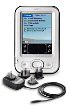 I mean, are you really going to do what i do? I keep my passwords encrypted on my Palm Pilot. Not only is my Palm backed up, but i have an identical Palm that i periodically restore to. If the Palm is lost, no one will be able to get my passwords. If my Palm breaks (computers are not immortal, and portable computers are particularly mortal), then i can use my backup unit. If both are lost, i can buy a new one, restore to it, and get back on the air. If my backup computer is stolen, i can buy a new computer, restore from my off site backup, buy a Palm, restore to it, and i'm back on the air. When the Universe (Murphy) is out to get you, paranoid is just good sense.
Security is one of those things you simply have to know. My advise: write all your passwords down on sticky notes and put them on your monitor. Sure, from a security standpoint, this is terrible. Anyone looking over your shoulder (even if your shoulder isn't there) could get into anything you can. But at least you'd know what you're doing.
I mean, are you really going to do what i do? I keep my passwords encrypted on my Palm Pilot. Not only is my Palm backed up, but i have an identical Palm that i periodically restore to. If the Palm is lost, no one will be able to get my passwords. If my Palm breaks (computers are not immortal, and portable computers are particularly mortal), then i can use my backup unit. If both are lost, i can buy a new one, restore to it, and get back on the air. If my backup computer is stolen, i can buy a new computer, restore from my off site backup, buy a Palm, restore to it, and i'm back on the air. When the Universe (Murphy) is out to get you, paranoid is just good sense.
Monday, March 12, 2007
In need
Overheard this morning.
Is there anything else you need?
Yes. I need another hour of sleep. Can you get me one?
I'm new here. Let me check the desk.
Is there anything else you need?
Yes. I need another hour of sleep. Can you get me one?
I'm new here. Let me check the desk.
Friday, March 09, 2007
Signs In The Sky
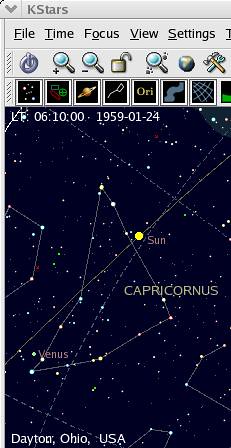 If you view my profile, you'll see that i'm older than i look. And, yes, exercise, diet and clean living have made quite a contribution. But you'll also see things that aren't intended.
For example, you'll see Zodiac Year: Dog (bow wow, or some such). This would be the Chinese year. I didn't write that. It was computed (correctly) from my birth date. From Chinese restaurant place mats, i'd long thought that i was a Zodiac Year: Pig (oink, oink). But since there was a full moon within hours of the Winter Solstice in 1958, the Chinese new year (based on a lunar calendar) came fairly late in 1959, at least a week into February. So, it's all gone to the dogs for me. I read a 60+ page pdf on the subject, and that's my best guess. Yet, despite all my calculations, i know little and care even less about Chinese astrology. Even if it was a brown dog year.
But there is also a bullet point, Astrological Sign: Aquarius. Now most people would say that January 24th makes me Aquarius. But if you examine the above image, the Sun was clearly in Capricornus - so i'm a Capricorn, right? So why does nearly everyone say i'm Aquarius? Well, that's because astrology has been around for a long time, and the Earth has had enough time to move in it's precession of the equinoxes. My guess is that since the changes have been quite slow, astrologers, who basically do what they've been taught, haven't updated the dates for the zodiac signs.
I'm not here to bash BlogSpot for making bogus calculations. I'm not here to bash astrology in it's various forms. My point is really that not everything you read is either correct or even what was intended. In this case, since i lean more towards astronomy than astrology, if you want to know what i think of my birth sign, it just isn't the historic Aquarius answer. Oh, and you'll be hard pressed to convince me that the alignment of the Sun on my birthdate to the arbitrary grouping of stars we call Capricorn has any cosmic significance to me or anyone else.
I normally post this sort of thing on my Live Journal blog, which i've attempted to devote to astronomical humor. But that blog doesn't put my signs in my profile.
Tuesday, March 06, 2007
Book It
As a parent of a ten year old, i have to say that the Book It program is good. There's a real problem getting kids up to the level of reading for enjoyment. That's the point at which the effort required to read is less than the return. Once they're there, getting them to read is no problem, generally. Just put books they'll like in front of them.
Book It did not get my child through this hurdle. The primary incentive was that (mostly) i read to him every day. I read stories that i knew he'd enjoy. Then, on October 11th, 2005 (it was a Tuesday), he crossed it. He went from kicking and screaming to get through five minutes of reading he had to do for school, to reading for six hours at a stretch on his own. This crossing really happened all of a sudden. And he went from hopelessly behind his class to reading over level in a few months. More on that in a bit.
Though the Book It program didn't do it, it did help. And it probably helps get lots of kids through reading for enjoyment. Pizza Hut runs this program. Many schools and parents cooperate by keeping track of what the kids read. At the end of each month, if the child has fulfilled the minimum requirement, they get a coupon for a personal pan pizza.
OK. I recognize that Book It amounts to a "buy one, get one free" sort of deal. He gets his free pizza, but i buy my own. And Pizza Hut doesn't lose money. On the contrary, i probably go there more often than i would without this program. It's still a good idea.
One result is startling. The house was quiet the other day. On a sneak inspection, i quickly opened his door, only to find him reading Shoestrings.
So, Book It has critics. But obesity is not one of my son's problems. And one personal pan pizza a month is not going to make any difference. You may consider pizza to be junk food, but it isn't banned by the South Beach Diet. If pizza has a problem, it's that it tastes good. My spaghetti has this problem too.
So, how do you get a child to read over level? Easy. Once (s)he's reading for enjoyment, put a book in front of them that's slightly over their level that is compelling. For example, Harry Potter. Rowlings deserves all the accolades she's gotten, and more. Six months after really starting to read, he'd read the first five books. Why didn't he read book six? Well, it wasn't out yet.
Having gotten him through reading, i'm now working on arithmetic. He was at the grocery store with me the other day. He wanted yogurt. Sure, it's filled with sugar, and probably isn't the best for him, but i still meter them out at just one per day. The pack of 6 was $2.69. While at the store, i asked him how much each one was. We did the division problem out loud. 6 goes into 26 how many times? 4. What's 6 times 4? 24. What's 26 minus 24? 2. Drop down the nine for what? 29. How many times does 6 go into 29? Five. Five? Oh, sure. He's doing estimates in class. So each yogurt costs how much? 45 cents. How much is Michigan tax? There's no tax on food. Then we bought it. I've edited out the spots where he didn't get to the next step instantly, of course.
Next up is science.
Book It did not get my child through this hurdle. The primary incentive was that (mostly) i read to him every day. I read stories that i knew he'd enjoy. Then, on October 11th, 2005 (it was a Tuesday), he crossed it. He went from kicking and screaming to get through five minutes of reading he had to do for school, to reading for six hours at a stretch on his own. This crossing really happened all of a sudden. And he went from hopelessly behind his class to reading over level in a few months. More on that in a bit.
Though the Book It program didn't do it, it did help. And it probably helps get lots of kids through reading for enjoyment. Pizza Hut runs this program. Many schools and parents cooperate by keeping track of what the kids read. At the end of each month, if the child has fulfilled the minimum requirement, they get a coupon for a personal pan pizza.
OK. I recognize that Book It amounts to a "buy one, get one free" sort of deal. He gets his free pizza, but i buy my own. And Pizza Hut doesn't lose money. On the contrary, i probably go there more often than i would without this program. It's still a good idea.
One result is startling. The house was quiet the other day. On a sneak inspection, i quickly opened his door, only to find him reading Shoestrings.
So, Book It has critics. But obesity is not one of my son's problems. And one personal pan pizza a month is not going to make any difference. You may consider pizza to be junk food, but it isn't banned by the South Beach Diet. If pizza has a problem, it's that it tastes good. My spaghetti has this problem too.
So, how do you get a child to read over level? Easy. Once (s)he's reading for enjoyment, put a book in front of them that's slightly over their level that is compelling. For example, Harry Potter. Rowlings deserves all the accolades she's gotten, and more. Six months after really starting to read, he'd read the first five books. Why didn't he read book six? Well, it wasn't out yet.
Having gotten him through reading, i'm now working on arithmetic. He was at the grocery store with me the other day. He wanted yogurt. Sure, it's filled with sugar, and probably isn't the best for him, but i still meter them out at just one per day. The pack of 6 was $2.69. While at the store, i asked him how much each one was. We did the division problem out loud. 6 goes into 26 how many times? 4. What's 6 times 4? 24. What's 26 minus 24? 2. Drop down the nine for what? 29. How many times does 6 go into 29? Five. Five? Oh, sure. He's doing estimates in class. So each yogurt costs how much? 45 cents. How much is Michigan tax? There's no tax on food. Then we bought it. I've edited out the spots where he didn't get to the next step instantly, of course.
Next up is science.
Subscribe to:
Comments (Atom)

 Posts
Posts